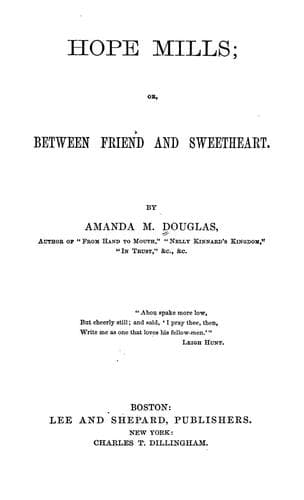
Hope Mills; Or, Between Friend and Sweetheart — John Shaqi
Hope Mills; Or, Between Friend and SweetheartDouglas, Amanda M.
Philosophy
Hope Mills; Or, Between Friend and Sweetheart
Douglas, Amanda M.
Fiction
Yerbury was on a strike. There had been a new scale of prices with the
opening of autumn, submitted to by most of the men with a sympathetic
good-nature. Trade was getting dull. Fancy prices no longer ruled. An
ominous feeling pervaded all classes. Building fell off. One tenant gave
up his house, and took part with another. Housewives looked about for
the cheapest market, and talked of making last year's coat or cloak do
for the winter.
Hope Mills had been among the first to propose this second reduction.
David Lawrence had returned from his business tour much depressed. There
was an undercurrent of distrust, a disinclination to lay in stock, a
wordless questioning from eye to eye, with no hopeful response.
Horace Eastman had worked himself into the charge of the inside
business. He had no real interest, but a liberal salary; and Mr.
Lawrence felt that he lifted a weight of care from his shoulders. If
only Fred-- But with college training and elegant tastes he could hardly
be expected to take to the dull routine of business cares. So matters
had been left more and more to Eastman, who was shrewd and sharp, who
always managed to get the most for his money.
Now Mr. Lawrence was appalled by the amount of stock on hand. They had
been running the mills at full capacity all summer.
"We must offer goods at a lower figure," said Mr. Eastman promptly. "We
must get command of trade again. Prices _will_ come down,--that is a
foregone conclusion. The abundant harvests have glutted the market, and
living will be cheaper. The laborer can live on less; and, if we can
manufacture at less cost, we shall be all right again."
"But there seems no demand for goods," said Mr. Lawrence faintly.
"Store-shelves are full. People are carrying last year's stock with no
call for it. It has always seemed to me, Eastman, that a liberal policy
to workmen brought its own reward. They are large consumers. Cut them
down to mere food and shelter, and clothes are the first to go. In
decent times your workman is ashamed of a ragged coat."
"All very true, Mr. Lawrence; but, if there is no market, we must create
one. Sell cheaper stock to new men. That will make a demand at once."
"Undersell! We used to call that a cut-throat business, Mr. Eastman;"
and a flush stained the fine face, now rather worn and thin.
"It is what we must come to. There is next to no premium on gold, and
the first man who touches bottom will be the lucky one, to my thinking.
Cheap goods, cheap every thing, will be the next cry. The farmers must
dispose of their wool, and labor must come down. Why, ordinary workmen
have been living like princes."
The delicate brows were drawn thoughtfully.
Public-domain text, read in full here on John Shaqi.
Reviews
Reviews
No reviews yet
Be the first to share your thoughts on this work.
Join the Discussion
Join the discussion
Sign in to leave a comment or review.
Sign InorCreate an account