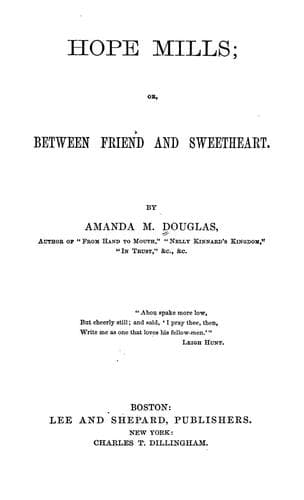
Hope Mills; Or, Between Friend and SweetheartDouglas, Amanda M.
Philosophy
Hope Mills; Or, Between Friend and Sweetheart
Douglas, Amanda M.
Fiction
"That's about the upshot of what I said. You see, Miss Barry, people
have been earning so much money of late years, that sewing has gone out
of fashion. It didn't pay to do this or that, so they earned and spent.
Now they sit listless in their dirt and rags, bemoaning hard times. It
is good to know how to do more than one thing," and Miss Morgan nodded
her head confidently, her strong face full of earnestness.
"Why can't you and Sylvie start a school--what shall we call it?--of
useful and homely arts? You see, the girls do work in the mills and
shops until they get married, and then they do not know how to make the
best of their husbands' money. But don't crowd out all the beauty and
the pleasure; there must be something to enlist the heart. Give a man an
interest in a thing, and you awake a new feeling, an enthusiasm that
makes every thing go as smoothly as oiling up machinery."
"I have often thought," said Mrs. Darcy in her soft, gentle voice,
"that the poor did not get as much good of their money as the better
classes, because they never have enough to buy advantageously, and
store-keepers so often take the advantage of them. Now, yesterday I was
over to Mrs. Hall's, and the poor thing was trying to make some bread,
and she was not fit to stand up and knead it; so I thought I'd try. The
flour was heavy and sticky and lumpy, and what I should call very
unprofitable. No one could make good bread out of it. She said they
traded at Kilburn's, because he would wait if they did not have the
money. The flour was seven and a half a barrel; the eighth, ninety-five
cents; and I do not believe the bread was fit to eat. So you must
remember, when you blame people for poor cooking, that they may not
always have decent materials to work with."
"Maverick was growling about Kilburn the other evening. It is a shame
that he should sell such poor goods, when prices have come down a good
deal."
"Can you not reform him a little?" and Mrs. Darcy smiled.
"Cousin Jane and Sylvie might go into business, as did the poor weavers
of Toad Lane, with their sack of oatmeal, firkin of butter, a little
sugar and flour," said Jack laughingly. "A fair division of labor. The
men of Yerbury shall provide work, and the women shall train the
inefficient how and where to spend money."
Sylvie glanced up with bright, inquiring eyes.
"Was it some more co-operation?" she asked.
Jack brought out his book, and read the story of the "Equitable Pioneers
of Rochdale" and their wonderful success from a small beginning. The
girl listened with wide-open eyes, and even Jane Morgan laid down her
knitting.
"The queen-bee and the workers again," said she, as Jack closed the
book. "It is not every man for himself, but every man for each other.
And it comes back, always."
CHAPTER XII.
"WHERE is grandmother?" Jack asked one morning late in May, as he came
in from the garden, and found her place at the table vacant.
Public-domain text, read in full here on John Shaqi.
Reviews
Reviews
No reviews yet
Be the first to share your thoughts on this work.
Elsewhere in the archive
Join the Discussion
Join the discussion
Sign in to leave a comment or review.
Sign InorCreate an account