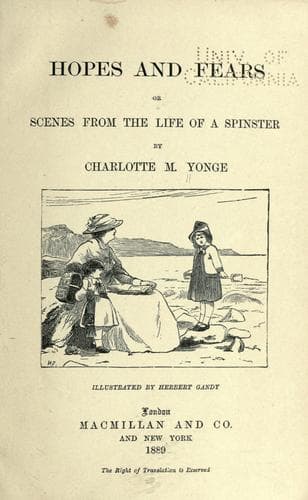
Hopes and Fears: or, scenes from the life of a spinsterYonge, Charlotte M. (Charlotte Mary)
General
Hopes and Fears: or, scenes from the life of a spinster
Yonge, Charlotte M. (Charlotte Mary)
England -- Social conditions -- 19th century -- Fiction; Single women -- Fiction
Phoebe and Miss Charlecote glanced at each other, aware that Mervyn would
never have condescended to sleep in Great Whittington-street. Mr.
Parsons likewise perceived a straight-forwardness in the manner, which
made him ready to acknowledge his fellow-Wykehamist and his son's
acquaintance; and they quickly became good friends over recollections of
Oxford and Winchester, tolerably strong in Mr. Parsons himself, and all
the fresher on 'William's' account. Phoebe, whose experience of social
intercourse was confined to the stately evening hour in the drawing-room,
had never listened to anything approaching to this style of conversation,
nor seen her brother to so much advantage in society. Hitherto she had
only beheld him neglected in his uncongenial home circle, contemning and
contemned, or else subjected to the fretting torment of Lucilla's
caprice. She had never known what he could be, at his ease, among
persons of the same way of thinking. Speaking scarcely ever herself, and
her fingers busy with her needle, she was receiving a better lesson than
Miss Fennimore had ever yet been able to give. The acquiring of
knowledge is one thing, the putting it out to profit another.
Gradually, from general topics, the conversation contracted to the parish
and its affairs, known intimately to Mr. Parsons a quarter of a century
ago, but in which Honora was now the best informed; while Robert listened
as one who felt as if he might have a considerable stake therein, and
indeed looked upon usefulness there as compensation for the schemes he
was resigning.
The changes since Mr. Parsons's time had not been cheering. The late
incumbent had been a man whose trust lay chiefly in preaching, and who,
as his health failed, and he became more unable to cope with the crying
evils around, had grown despairing, and given way to a sort of dismal,
callous indifference; not doing a little, because he could not do much,
and quashing the plans of others with a nervous dread of innovation. The
class of superior persons in trade, and families of professional men, who
in Mr. Charlecote's time had filled many a massively-built pew, had
migrated to the suburbs, and preserved only an office or shop in the
parish, an empty pew in the church, where the congregation was to be
counted by tens instead of hundreds. Not that the population had fallen
off. Certain streets which had been a grief and pain to Mr. Charlecote,
but over which he had never entirely lost his hold, had become
intolerably worse. Improvements in other parts of London, dislodging the
inhabitants, had heaped them in festering masses of corruption in these
untouched byways and lanes, places where honest men dared not penetrate
without a policeman; and report spoke of rooms shared by six families at
once.
Public-domain text, read in full here on John Shaqi.
Reviews
Reviews
No reviews yet
Be the first to share your thoughts on this work.
Elsewhere in the archive
Join the Discussion
Join the discussion
Sign in to leave a comment or review.
Sign InorCreate an account