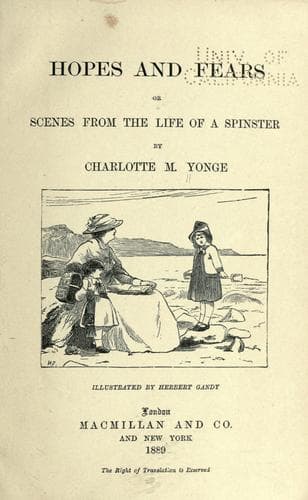
Hopes and Fears: or, scenes from the life of a spinsterYonge, Charlotte M. (Charlotte Mary)
General
Hopes and Fears: or, scenes from the life of a spinster
Yonge, Charlotte M. (Charlotte Mary)
England -- Social conditions -- 19th century -- Fiction; Single women -- Fiction
It was a dreary wedding, in spite of London grandeur. In all her
success, Juliana could not help looking pinched and ill at ease, her
wreath and veil hardening instead of softening her features, and her
bridegroom's studious cheerfulness and forced laughs became him less than
his usual silent dejection. The Admiral was useful in getting up stock
wedding-wit, but Phoebe wondered how any one could laugh at it; and her
fellow-bridesmaids, all her seniors, seemed to her, as perhaps she might
to them, like thoughtless children, playing with the surface of things.
She pitied Sir Bevil, and saw little chance of happiness for either, yet
heard only congratulations, and had to be bright, busy, and helpful,
under a broad, stiff, white watered silk scarf, beneath which Juliana had
endeavoured to extinguish her, but in which her tall rounded shape looked
to great advantage. Indeed, that young rosy face, and the innocently
pensive wondering eyes were so sweet, that the bride had to endure
hearing admiration of her sister from all quarters, and the Acton
bridemaidens whispered rather like those at Netherby Hall.
It was over, and Phoebe was the reigning Miss Fulmort. Her friends were
delighted for her and for themselves, and her mother entered on the full
enjoyment of the little brougham.
CHAPTER XI
When some dear scheme
Of our life doth seem
Shivered at once like a broken dream
And our hearts to reel
Like ships that feel
A sharp rock grating against their keel.--C. F. A.
It was high summer; and in spite of cholera-averting thunderstorms, the
close streets and the odour of the Thames were becoming insufferable.
Mr. Parsons arranged a series of breathing times for his clerical staff,
but could make Robert Fulmort accept none. He was strong and healthy,
ravenous of work, impervious to disgusts, and rejected holidays as
burdensome and hateful. Where should he go? What could he do? What
would become of his wild scholars without him, and who would superintend
his buildings?
Mr. Parsons was fain to let him have his own way, as had happened in some
previous instances, specially the edifice in Cicely Row, where the
incumbent would have paused, but the curate rushed on with resolute zeal
and impetuosity, taking measures so decidedly ere his intentions were
revealed, that neither remonstrance nor prevention were easy, and a
species of annoyed, doubtful admiration alone was possible. It was
sometimes a gratifying reflection to the vicar, that when the buildings
were finished, Whittingtonia would become a district, and its busy curate
be no longer under his jurisdiction.
Public-domain text, read in full here on John Shaqi.
Reviews
Reviews
No reviews yet
Be the first to share your thoughts on this work.
Elsewhere in the archive
Join the Discussion
Join the discussion
Sign in to leave a comment or review.
Sign InorCreate an account