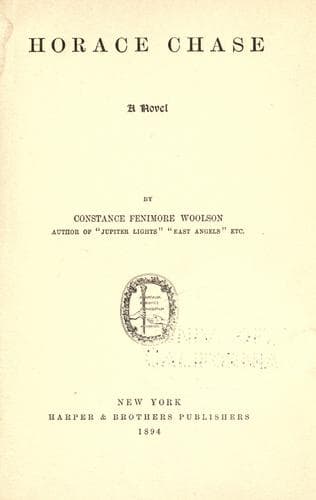
Didactic fiction; Men -- United States -- Fiction; United States -- Social life and customs -- 19th century -- Fiction
Two days after the Indian party at Andalusia, the excursion which Mrs.
Kip had called a "boat-drive" came off. Horace Chase was still absent;
he had telegraphed to his wife that he could not return before the last
of the week. As all the preparations had been made, the excursion was
not postponed on his account. Nor was there any reason why it should be.
It was not given in honor of his wife, especially; Ruth, after sixteen
months of marriage, could hardly be called a bride. In addition, the
little winter colony had learned that an hour or two of their leisurely
pleasure-making was about as much as this man of affairs could enjoy
(some persons said "could endure"); after that his face was apt to
betray a vague boredom, although it was evident that (with his usual
careful politeness) he was trying to conceal it.
Walter Willoughby, meanwhile, was making the best of an annoying
situation. He had lost the chance of being introduced to David
Patterson, and with it the opportunity of learning something definite,
at last, about Chase's Californian interests, and this seemed to him a
great misfortune. But there was no use in moaning over it; the course to
follow was not still further to lose the five days of Chase's absence
in sulking, but to employ them in the only profitable way that was left
open (small profit, but better than nothing)--namely, in cementing still
further a friendly feeling between himself and Chase's wife, that
butterfly young wife who had been the cause of so many of his
disappointments. "Every little helps, I suppose," he said to himself,
philosophically. "And as the thing she likes best, apparently, is to go
and keep going, why, I'll take her own pace and outrace her--the little
gad-about!" For, to Walter's eyes, Ruth appeared very young; mentally
unformed as yet, child-like. His adjective "little" could, in truth,
only be applied to her in this sense, for in actual inches Mrs. Chase
was almost as tall as he was. Walter was of medium height, robust and
compact. He had a well-shaped, well-poised head, which joined his strong
neck behind with no hollow and scarcely a curve. His thick, dark hair
was kept very short; but, with his full temples and facial outlines,
this curt fashion became him well. He was not called handsome, though
his features were clearly cut and firm. His gray eyes were ordinarily
rather cold. But when he was animated--and he was usually very
animated--young Willoughby looked full of life. He was fond of pleasure,
fond of amusement. But this did not prevent his possessing, underneath
the surface, a resolute will, which he could enforce against himself as
well as against others. He intended to enjoy life. And as, according to
his idea, there could be no lasting enjoyment without freedom from the
pinch of anxiety about material things, he also intended to get
money--first of all to get money. "For a few years, while one is young,
to have small means doesn't so much matter," he had told himself. "But
Public-domain text, read in full here on John Shaqi.
Reviews
Reviews
No reviews yet
Be the first to share your thoughts on this work.
Elsewhere in the archive
Join the Discussion
Join the discussion
Sign in to leave a comment or review.
Sign InorCreate an account