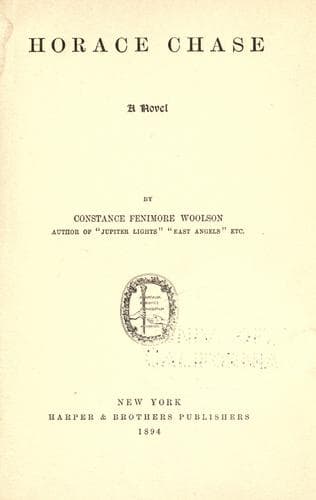
Didactic fiction; Men -- United States -- Fiction; United States -- Social life and customs -- 19th century -- Fiction
She spoke to her mother, but Walter overheard the words. He went across
to the musicians (in reality he bribed them); then returning, he said:
"I've arranged it, Mrs. Chase. You are to have that one waltz more." A
few of the young people, tempted by the revived strains, threw aside
their wraps and joined them, but practically they had the floor to
themselves. Walter was an expert dancer, skilful and strong; he bore his
partner down the long room, guiding her so securely that she was not
obliged to think of their course; she could leave that entirely to him,
and give herself up to the enjoyment of the motion. As they returned
towards the music for the third time, she supposed that he would stop.
But he did not; he swept her down again, and in shorter circles that
made her, light as she was on her feet, a little giddy. "Isn't this
enough?" she asked. But apparently he did not hear her. The floor began
to spin. "Please stop," she murmured, her eyes half closing from the
increasing dizziness. But her partner kept on until he felt that she was
faltering; then, with a final bewildering whirl, he deposited her safely
on a bench, and stood beside her, laughing a little.
There was no one near them; Mrs. Franklin, Mrs. Kip, and the few who
still remained, were at the other end of the room. Ruth, after a moment,
began to laugh also, while she pressed her hands over her eyes to help
herself see more clearly. "What possessed you?" she said. "Another
instant and I should certainly have fallen; I couldn't see a thing!"
"No, you wouldn't have fallen, Mrs. Chase; I could have held you up
under any circumstances. But I wanted to make you for once acknowledge
that we are not all so lethargic as you constantly accuse us of being."
"Accuse?" said Ruth, surprised. She was still panting.
"Yes, you accuse the whole world; you do nothing _but_ accuse. You are
never preoccupied yourself, and so preoccupation in others seems to you
stupidity. You are never tired; so the rest of us strike you as owlish
and lazy."
"Oh, but I'm often lazy myself," protested Ruth.
"Precisely. No doubt when you go in for being lazy at all, you carry it
further than any poor, dull, reasonable man would ever dream of doing,"
Walter went on. "I dare say you are capable of lying motionless on a
sofa, with a novel, for ten hours at a stretch!"
"Ten hours? That's nothing. Ten days," answered Ruth. "I have spent ten
days at L'Hommedieu in that way many a time; Maud Muriel used to call it
'lucid stupor.'"
"Lucid?" said Walter, doubtfully. "Do you think you can walk?" he went
on, as her mirth still continued. "Because the music really has stopped
this time, and I see your mother's eyes turning this way. Your laughs
are perfectly beautiful, of course. But do they leave you your walking
powers?"
The musicians, seeing them rise, began suddenly to play again (for his
bribe had been a generous one), and he took her back to her mother in a
rapid _deux temps_.
Public-domain text, read in full here on John Shaqi.
Reviews
Reviews
No reviews yet
Be the first to share your thoughts on this work.
Elsewhere in the archive
Join the Discussion
Join the discussion
Sign in to leave a comment or review.
Sign InorCreate an account