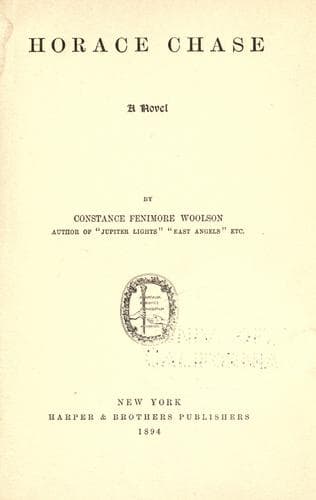
Didactic fiction; Men -- United States -- Fiction; United States -- Social life and customs -- 19th century -- Fiction
Walter devoting himself to Mrs. Chase for his own purposes, had never
had the slightest intention of falling in love with her; in truth, such
a catastrophe (it would have seemed to him nothing less) would have
marred all his plans. He had wished only to amuse her. And, in the
beginning, it had been in truth his gay spirits which had attracted
Ruth, for she possessed gay spirits herself. She had been unaware of the
nature of the feeling which was taking possession of her; her
realization went no further than that life was now much more
interesting; and, with her rich capacity for enjoyment, she had grasped
this new pleasure eagerly. It was this which had made her beauty so much
more rich and vivid. It was this which had caused her to exclaim, "How
delightful it is to live!" If obstacles had interfered, the pain of
separation might have opened her eyes, at an earlier period, to the
nature of her attachment. But, owing to the circumstances of the case,
the junior partner had been with Mr. and Mrs. Chase almost daily ever
since their return from Europe. That announcement, therefore, out on the
barrens--his own announcement--of his departure the next morning, and
for an indefinite stay, had come upon her like the chill of sudden
death. And then in the evening, while she was still benumbed and
pulseless, had followed his strange, short visit, and the wild thrill of
joy in her heart over his declaration of his own love for her. For he
had said it, he had said it!
These two conflicting tides--the pain of his absence and the joy of his
love--had held entire possession of her ever since. But passionate
though her nature was, in matters of feeling it was deeply reticent as
well, and no one had noticed any change in her save Dolly, Dolly who had
divined something from her sister's new desire to be alone. Never before
had Ruth wished to be alone; but now she went off for long walks by
herself; and this plan for returning to New York by sea--that was simply
the same thing. From the moment of Ruth's engagement, Dolly had been
haunted by a terrible fear. Disliking Horace Chase herself, she did not
believe that he would be able to keep forever a supreme place in his
wife's heart. And then? Would Ruth be content to live on, as so many
wives live, with this supreme place unoccupied? It was her dread of
this, a dread which had suddenly become personified, that had made her
form one of almost all the excursions of this Florida winter; she had
gone whenever she was able, and often when she was unable--at least, she
would be present, she would mount guard.
But in spite of her guardianship, something had evidently happened. What
was it? Was this desire of Ruth's to be alone a good sign or a bad sign?
Did it come from happiness or unhappiness? "If it is unhappiness, she
will throw it off," Dolly told herself. "She hates suffering. She will
manage, somehow, to rid herself of it." Thus she tried to reassure
herself.
Public-domain text, read in full here on John Shaqi.
Reviews
Reviews
No reviews yet
Be the first to share your thoughts on this work.
Elsewhere in the archive
Join the Discussion
Join the discussion
Sign in to leave a comment or review.
Sign InorCreate an account