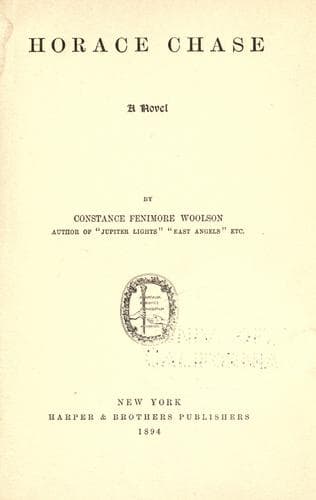
Didactic fiction; Men -- United States -- Fiction; United States -- Social life and customs -- 19th century -- Fiction
Though she was so white, it was evident that she had not shed tears; her
eyes were bright, her lips were parched. Her husband, with his
rough-and-ready knowledge of women, knew that it would be better for her
to "have her cry out," as he would have phrased it; it would quiet her
excitement and subdue her so that she would sleep. As she could not eat,
he gave her a spoonful of brandy from his own flask, and wrapped her
cold feet in his travelling-shawl; then, putting her on the sofa, he sat
down beside her, and, holding her tenderly in his arms, he told her the
story of Jared's last hours.
His account was truthful, save that he softened the details. In his
narrative Mrs. Nightingale's shabby house became homelike and
comfortable, and Jared's bare attic a pleasant place; Mrs. Nightingale
herself (here there was no need for exaggeration) was an angel of
kindness. He dwelt upon Jared's having agreed to go with him to New
York. "I had planned to start at nine o'clock the next morning, Ruthie,
having a doctor along without his knowing it; and I had ordered a
private car--a Pullman sleeper--to go through to New York; once there, I
thought you could make him take a good long rest. That kind woman had
been sitting up at night in the room next to his. So I fixed that by
taking the same room myself. I didn't undress, but I guess I fell
asleep; and I woke up hearing him talking. And then he walked about the
room, and he even climbed out on the roof; but we soon got him back all
right. Everything possible was done, dear; the best doctor in Raleigh,
and a nurse--two of 'em. But it was no use. It was brain-fever, or
inflammation of the brain rather, and after it had left him he was too
weak to rally. They thought everything of him at Raleigh; your mother
wanted him brought here, and when we went to the depot, everybody who
had ever known him turned out, so that there was a long procession; and
all the ladies of his boarding-house brought flowers. At Old Fort, I had
intended to let Hill (I had wired to him to meet us there) take charge
of them across the mountains, for I wanted to go to New York to get
_you_. But the night was dark, and the road is always so bad that I
thought, on the whole, you'd rather have me stay with your mother. And
she has been tolerably well, too, until this afternoon, when she had an
attack of some sort. But I guess it's only that she is overtired; the
doctor will probably come down and tell us so before long."
"I _wanted_ to see him," repeated Ruth, her eyes still dry and bright.
"It was very little to do for me, I think. If I could have just taken
his poor hand once--even if it _was_ dead! Everybody else got there in
time to speak to him, to say good-by."
"No; your mother didn't get there," Chase explained.
"She didn't get there? And Genevieve _did?_ I know it by your face. Let
me go to mother--poor mother! Let me go to her, and _never_ leave her
again."
Public-domain text, read in full here on John Shaqi.
Reviews
Reviews
No reviews yet
Be the first to share your thoughts on this work.
Elsewhere in the archive
Join the Discussion
Join the discussion
Sign in to leave a comment or review.
Sign InorCreate an account