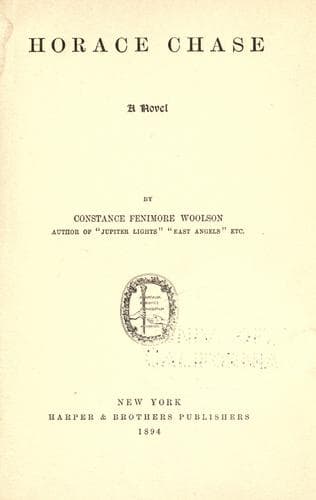
Didactic fiction; Men -- United States -- Fiction; United States -- Social life and customs -- 19th century -- Fiction
For he would be sure to come before long. The veranda was always the
sitting-room; it commanded that wide view of the mountains far and near
which had caused Nicholas Willoughby, at the cost of much money and
trouble, to perch his cottage just here. The friends to whom he had lent
The Lodge had left it ten days before, as Ruth knew. A man and his wife
were always in charge, but when they were alone the front of the house
was kept closed. To-day the windows were all open, a rising breeze
swayed the curtains to and fro, and there were numerous other signs of
Walter's presence; on the veranda were several easy-chairs and a lounge,
besides a table with books and papers. And wasn't that the hat he had
worn when she saw him talking to the farmer the day before? Yes, it was
the same. "What time can it be?" she thought. She had not her watch
with her--the costly diamond-decked toy which Horace Chase had given
her; she had left it with her rings on the toilet-table at L'Hommedieu.
Her wedding-ring was there also. But this was not from any plan about
it; she always took off her rings at night. She had simply forgotten to
put them on.
After ten minutes of waiting her heart gave a leap--she heard Walter's
voice within the house. "That is a woman answering. He is talking to the
housekeeper," she said to herself.
But presently there seemed to be three voices. "It is another servant,"
she thought. Then, before she had time to recognize that the intonations
were not those of the mountain women (who were the only resource as
servants in this remote spot), Walter Willoughby himself came into view,
pushing aside the curtains of one of the long windows that opened on the
veranda.
But before Ruth could detach herself from the branches that surrounded
her, he had drawn back again to make room for some one else, and a lady
came out. He followed this lady; he took his seat familiarly upon the
lounge where she had placed herself. It was Marion Barclay, the
handsome, inanimate girl who, with her father and mother, had spent some
weeks at St. Augustine during the preceding winter.
Marion was no longer inanimate. The fault of her finely chiselled face
had been its coldness; but there was no coldness now as Walter
Willoughby took her hand and pressed it to his lips.
At this moment Mrs. Barclay, Marion's mother, appeared. "Well, Darby and
Joan," she said, smiling, as she established herself in the most
comfortable chair.
Mrs. Barclay had favored Walter's suit from the first. It was her
husband who had opposed it. Christopher Barclay had, in fact, opposed it
so strongly that at St. Augustine he had dismissed young Willoughby with
a very decided negative. It was while held at bay by this curt refusal
that young Willoughby had entertained himself for a time by a fresh
study of Mrs. Horace Chase.
Public-domain text, read in full here on John Shaqi.
Reviews
Reviews
No reviews yet
Be the first to share your thoughts on this work.
Elsewhere in the archive
Join the Discussion
Join the discussion
Sign in to leave a comment or review.
Sign InorCreate an account