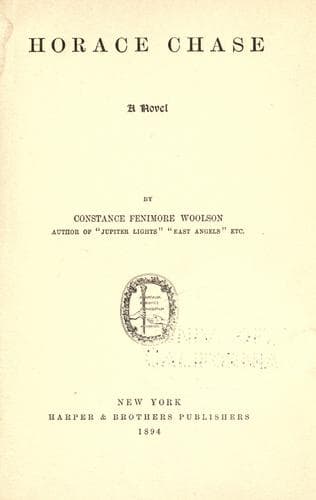
Didactic fiction; Men -- United States -- Fiction; United States -- Social life and customs -- 19th century -- Fiction
The lighted window was that of Portia Crumb. Portia had not gone to bed.
But she was not sitting up on their account; she supposed that they had
found shelter at one of several small houses that were scattered along
the river road in the direction which they had taken. She was sitting up
in order to minister to her "Dave." David Crumb's fits of drunkenness
generally lasted through two days. When he came to himself, his first
demand was for coffee, and his wife, who never could resist secretly
sympathizing a little with the relief which her surly husband was able
to obtain for a time from the grief which gnawed incessantly at her own
poor heart--his wife always remained within call to give him whatever he
needed. And, oddly enough, these vigils had become almost precious to
Portia. For occasionally at these moments David of his own accord would
talk of his lost boys--the only times he ever mentioned them or
permitted his wife to do so. And now and then he would allow her to read
her Bible to him, and even to sing a hymn perhaps, to which he would
contribute in snatches a growling repentant bass.
Portia's coffee-pot now stood on the hot coals of her kitchen fireplace;
she had been occupying the time in spinning, and in chanting softly to
herself, as the rain poured down outside:
[Illustration: musical notation:
Je -_ru_ -sa-lem, my hap-py _home_, Name ev-er de-ar tu
_me_, When _shell_ my la-ber-rs hev an end? Thy
joys when shell I see ? Thy-y joys when _shell-el_ I see?]
Then, hearing some one at the outer door, she had come to open it.
"Good Lors! Miss Dolly! Here!--lemme help you! Bring her right into the
kitchen, an' put her down on the mat clost to the fire till I get her
wet close off!"
CHAPTER XXIV
HORACE CHASE, having by hard work arranged his far-stretching affairs so
that he could leave them, reached L'Hommedieu late in the evening of the
day of Ruth's flight. He had not telegraphed that he was coming; his
plan was to have his wife well on her way to New York and the Liverpool
steamer almost before she knew it. She had always been fond of the
unexpected; this fondness would perhaps serve him now. When he reached
the old house, to which his money had given a new freshness, there was
no one to meet him but Dolly's Diana. Diana, in her moderate, unexcited
way, began to tell him what had happened. But she was soon re-enforced
by Felicite, whose ideas (regarding the same events) were far more
theoretic.
"Miss Franklin had a lunch prepared, and took it with her," Diana went
on.
"Eet ended in a peekneek," interrupted Felicite. "The leaf was so red,
and the time so beautiful, monsieur; no clouds, and the sky of a blue!
Then suddenlee the rain ees come. No doubt they have entered in a house
to wait till morning."
"Which road did my wife take?" inquired Chase, his tone anxious.
"Ah, monsieur, no one _see_ herr, she go so early. Eet was herr joke--to
escape a leetle from herr sistare, if eet is permit to say eet; pardon."
Public-domain text, read in full here on John Shaqi.
Reviews
Reviews
No reviews yet
Be the first to share your thoughts on this work.
Elsewhere in the archive
Join the Discussion
Join the discussion
Sign in to leave a comment or review.
Sign InorCreate an account