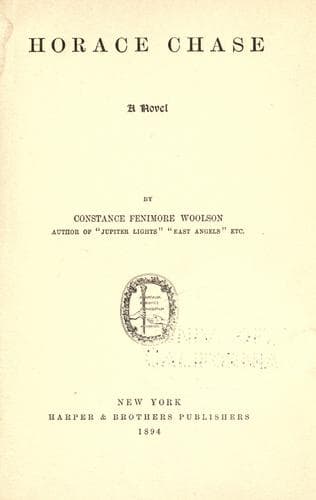
Didactic fiction; Men -- United States -- Fiction; United States -- Social life and customs -- 19th century -- Fiction
He had been thus engaged for nearly half an hour when a door opened
behind him, and Dolly Franklin came in.
She had no idea that he was there. The bedroom above, whose flight of
steep stairs she had just descended, possessed windows only towards the
river; and the second-story floors of the old house were so thick that
no sound from below could penetrate them. She had not therefore heard
Chase ride up on the other side; she had not distinguished any sounds in
the kitchen.
He jumped up when he saw her. "I'm _mighty_ glad you've come down,
Dolly. I've been afraid to disturb her. Is she awake?"
Dolly closed the door behind her. "No; she is sleeping soundly. I
wouldn't go up just now if I were you. A good sleep is what she needs
most of all."
"All right; I'll wait. But how in the world came she to be out so long
in the rain, and you too? That's the part I don't understand."
Dolly's heart had stood still when she saw her brother-in-law. "I'll sit
here for a while," she suggested, in order to gain time. "Will you
please pull forward that chair--the one in the corner? I had no idea you
were here. I only came down for the pillows from this bed; they are
better than those upstairs." While she was getting out these words her
quick mind had flown back to L'Hommedieu, and to the impression which
she had left behind her there, carefully arranged and left as
explanation of their absence. The explanation had been intended for any
of their friends who might happen to come to the house during the day.
But it would do equally well for Horace Chase, and Felicite could be
safely trusted to have repeated it to him within five minutes after his
unexpected arrival! For Felicite was not fond of Miss Dora Franklin. The
idea that her young mistress had gone off for a ride at daylight would
be an immense delight to the Frenchwoman, not for the expedition itself
(such amusements in a country so "sauvage" being beyond her
comprehension), but for the annoyance to mademoiselle--mademoiselle
whose watchfulness over everything that concerned her sister (even her
sister's maid) was so insupportably oppressive. Their start, therefore,
Dolly reflected, both Ruth's at dawn and her own a little later, was
probably in a measure accounted for in Horace Chase's mind. But as
regarded the hours in the rain, what could she invent about that? For
Portia had evidently described Ruth's exhaustion and their wet clothes.
She had seated herself by the fire; arrayed in one of the shapeless
dresses of her hostess, with her hair braided and hanging down her back,
her plain face looked plainer than ever. Worn out though she was, she
had not been asleep even for a moment; she had been sitting by the
bedside watching her sister. Ruth had lain motionless, with her head
thrown back lifelessly, her breathing scarcely perceptible. Whenever
Portia had peeped in (and the farmer's wife had stolen softly up the
stairs three times) Dolly had pretended to be asleep; and she knew that
Public-domain text, read in full here on John Shaqi.
Reviews
Reviews
No reviews yet
Be the first to share your thoughts on this work.
Elsewhere in the archive
Join the Discussion
Join the discussion
Sign in to leave a comment or review.
Sign InorCreate an account