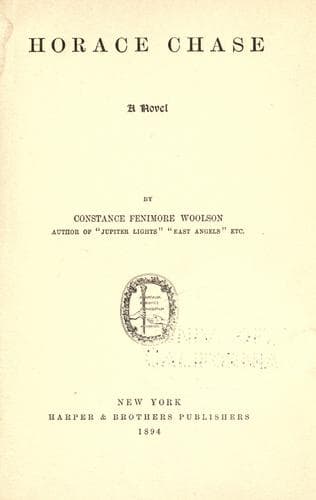
Didactic fiction; Men -- United States -- Fiction; United States -- Social life and customs -- 19th century -- Fiction
L'Hommedieu was decked with flowers. It was a warm autumn day, the
windows and doors were open. All Asheville was in attendance, if not in
the house and on the verandas, then gazing over the fence, and waiting
outside the gate. For there were many things to engage its attention.
First, there was Mrs. Franklin, looking very distinguished; then
Genevieve, the most beautiful woman present. Then there was Bishop
Carew, who had come from Wilmington to officiate. All Asheville admired
the bishop--the handsome, kindly, noble old man, full of dignity, full
of sweetness as well; they were proud that he had come to "their"
wedding. For that was the way they thought of it. Even the
negroes--those who had flocked to old Daniel's race--had a sense of
ownership in the affair.
A third point of interest was the general surprise over Maud. As Ruth
had selected the costumes of her bridesmaids, Miss Mackintosh was
attired for the first time in her life in ample soft draperies. Her
hair, too, arranged by Miss Billy, had no longer the look of the
penitentiary, and the result was that (to the amazement of the town) the
sculptress was almost handsome.
Anthony Etheridge, much struck by this (and haunted by his old idea),
pressed upon her a glass of punch.
"Take it," he urged, in a low tone, "take two or three. Then, as soon as
this is over, hurry to your studio and _let yourself go_. You'll do
wonders!"
Two of Chase's partners were present, Nicholas Willoughby, a
quiet-looking man of fifty-eight, and his nephew Walter of the same
name; Walter was acting as "best man." The elder Willoughby had made use
of the occasion to take a general look at this mountain country, with
reference to Chase's ideas concerning it, in order to make a report to
his brother Richard. For Nicholas and Richard were millionaires many
times over; their business in life was investment. Asheville itself,
meanwhile, hardly comprehended the importance of such an event as the
presence within its borders of a New York capitalist; it knew very
little about New York, still less about capitalists. Mrs. Franklin,
however, possessed a wider knowledge; she understood what was
represented by the name of Willoughby. And it had solaced her
unspeakably also to note that the uncle had a genuine liking for her
future son-in-law. "They have a real regard for him," she said to her
son, in private. "And I myself like him rather better than I once
thought I should."
Public-domain text, read in full here on John Shaqi.
Reviews
Reviews
No reviews yet
Be the first to share your thoughts on this work.
Elsewhere in the archive
Join the Discussion
Join the discussion
Sign in to leave a comment or review.
Sign InorCreate an account