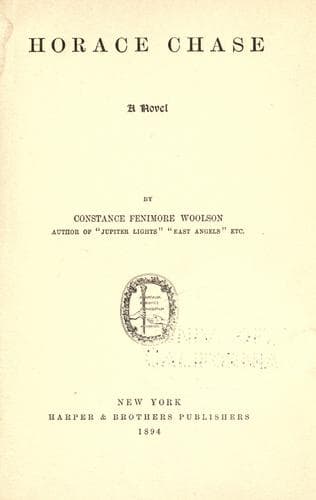
Didactic fiction; Men -- United States -- Fiction; United States -- Social life and customs -- 19th century -- Fiction
As there were no other passengers (save Petie Trone, Esq., asleep in his
travelling basket), Abram, the negro driver, gave up the reins with a
grin. Taking his station on the step, he then admonished the volunteer
from time to time as follows: "Dish yere's a bad bit; take keer, boss."
"Jess ahead de rail am splayed out on de lef'. Yank 'em hard to de
right, or we'll sut'ny run off de track. We ginerally _do_ run off de
track 'bout yere." On each side was a dense forest veiled in the gray
long moss. Could that be snow between the two black lines of track
ahead? No snow, however, was possible in this warm atmosphere; it was
but the spectral effect of the moonlight, blanching to an even paler
whiteness the silvery sand which formed the road-bed between the rails.
This sand covered the sleepers to such a depth that the mules could not
step quickly; there was always a pailful of it on each foot to lift and
throw off. They moved on, therefore, in a sluggish trot, the cow-bells
attached to their collars keeping up a regular tink-tank, tink-tank.
The tableau of her husband driving these spirited steeds struck Ruth as
comical. She was seated on a camp-stool by his side, and presently she
broke into a laugh. "Oh, you do look _so_ funny, Horace! If you could
only see yourself! You, so particular about horses that you won't drive
anything that is not absolutely perfect, there you stand taking the
greatest pains, and watching solemnly every quiver of the ear of those
old mules!"
They were alone, Abram having gone to the baggage-car to get his tin
horn. "Come, now, are you never going to stop making fun of me?"
inquired Chase. "How do you expect to hit St. Augustine to-night if this
fast express runs off the track?" But in spite of his protest, it was
easy to see that he liked to hear her laugh.
Abram, coming back, put the horn to his lips and blew a resounding
blast; and presently, round a curve, the half-way station came into
view--namely, a hut of palmetto boughs on the barren, with a bonfire
before it. The negro station-men, beguiling their evening leisure by
dancing on the track to their own singing and the music of a banjo, did
not think it necessary to stop their gyrations until the heads of the
mules actually touched their shoulders. Even then they made no haste in
bringing out the fresh team which was to serve as motive power to St.
Augustine, and Mr. and Mrs. Chase, leaving the car, strolled up and down
near by. The veiled forest had been left behind; the rest of the way lay
over the open pine-barrens. The leaping bonfire, the singing negroes,
and the little train on its elevated snow-like track contrasted with the
wild, lonely, silent, tree-dotted plain, stretching away limitlessly in
the moonlight on all sides.
"Perhaps Petie Trone, Esq., would like to take a run," said Ruth.
Hastening into the car with her usual heedlessness, she tripped and
nearly fell, Chase, who had followed, catching her arm just in time to
save her.
Public-domain text, read in full here on John Shaqi.
Reviews
Reviews
No reviews yet
Be the first to share your thoughts on this work.
Elsewhere in the archive
Join the Discussion
Join the discussion
Sign in to leave a comment or review.
Sign InorCreate an account