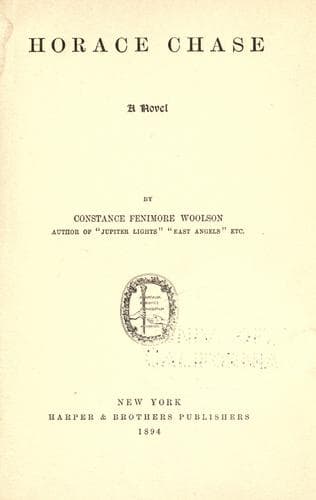
Didactic fiction; Men -- United States -- Fiction; United States -- Social life and customs -- 19th century -- Fiction
"But you must remember that Ruth did not come to Florida last winter
after her marriage. And this summer, when I was in Asheville, she was
abroad. And as none of you came south winter before last--don't you see
that it makes nearly _two_ years since I have seen her?" Mrs. Kip went
on. "In addition, marriage changes a woman's face so--deepens its
expression and makes it so _much_ more beautiful. I am sure, commodore,
that _you_ agree with me there?" And she turned to the only man present.
"Yes, yes," answered Etheridge, gallantly. In his heart he added: "And
therefore the more marriage the better? Is that what you are thinking
of, you idiot?"
The presence of Mrs. Kip always tore Etheridge to pieces. He had never
had any intention of marrying, and he certainly had no such intention
now. Yet he could not help admiring this doubly widowed Lilian very
deeply, after a fashion. And he knew, too--jealously and angrily he knew
it--that before long she would inevitably be led to the altar a third
time; so extremely marriageable a woman would never lack for leaders.
"Ruth is handsomer," remarked Mrs. Franklin; "otherwise she is
unchanged. You will see it for yourself, Lilian, when she comes."
The mother's tone was placid. All her forebodings had faded away, and
she had watched them disappear with thankful eyes. For Ruth was happy;
there could be no doubt about that. In the year that had passed since
her marriage, she had returned twice to Asheville, and Mrs. Franklin
also had spent a month at her son-in-law's home in New York. On all
these occasions it had been evident that the girl was enjoying greatly
her new life; that she was delightedly, exultantly, and gleefully
contented, and all in a natural way, without analyzing it. She delighted
in the boundless gratification of her taste for personal ease and
luxury; she exulted in all that she was able to do for her own family;
she was full of glee over the amusements, the entertainments, and
especially the change, that surrounded her like a boundless horizon. For
her husband denied her nothing; she had only to choose. He was not what
is known as set in his ways; he had no fixed habits (save the habit of
making money); in everything, therefore, except his business affairs, he
allowed his young wife to arrange their life according to her fancy.
This freedom, this power, and the wealth, had not yet become an old
story to Ruth, and, with the enjoyment which she found in all three, it
seemed as if they never would become that. It had been an immense
delight to her, for instance, to put L'Hommedieu in order for her
mother. A month after her marriage, on returning to Asheville for a
short visit, she had described her plan to Dolly. "And think what fun it
will be, Dolly, to have the whole house done over, not counting each
cent in Genevieve's deadly way, but just _recklessly_! And then to see
her squirm, and say 'surely!' And you and mother must pretend not to
Public-domain text, read in full here on John Shaqi.
Reviews
Reviews
No reviews yet
Be the first to share your thoughts on this work.
Elsewhere in the archive
Join the Discussion
Join the discussion
Sign in to leave a comment or review.
Sign InorCreate an account