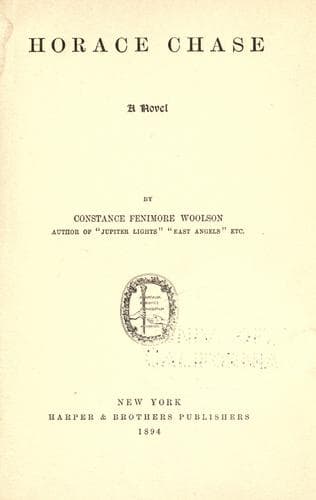
Didactic fiction; Men -- United States -- Fiction; United States -- Social life and customs -- 19th century -- Fiction
"We should take care that it is not too much so," Dolly answered. "Lots
of us are ridiculously uplifted. We know one thing perhaps, and like it.
But we remain flatly ignorant about almost everything else. In a busy
world this would do no harm, if we could only be conscious of it. But
no; on we go, deeply conceited about the one thing we know and like, and
loftily severe as to the ignorance of other persons concerning it. It
doesn't occur to us that upon other subjects save our own, we ourselves
are presenting precisely the same spectacle. A Beethoven, when it comes
to pictures, may find something very taking in a daub representing a
plump child with a skipping-rope, and the legend: 'See me jump!' A
painter of the highest power may think 'The Sweet By-and-By' on the
cornet the acme of musical expression. A distinguished sculptor may
appreciate on the stage only negro minstrels or a tenth-rate farce. A
great historian may see nothing to choose, in the way of beauty, between
a fine etching and a chromo. It is well known that the most celebrated,
and deservedly celebrated, scientific man of our day devours regularly
the weakest fiction that we have. And people who love the best classical
music and can endure nothing else, have no idea, very often, whether
they belong to the mammalia or the crustacea, or whether the Cologne
cathedral is Doric or late Tudor."
"Carry it a little further, Miss Franklin," said Walter Willoughby; "it
has often been noted that criminals delight in the most sentimental
tales."
"That isn't the same thing," Dolly answered. "However, to take up your
idea, Mr. Willoughby, it is certainly true that it is often the good
women who read with the most breathless interest the newspaper reports
of crimes."
"Oh no!" exclaimed Mrs. Kip.
"Yes, they do, Lilian," Dolly responded. "And when it comes to tales,
they like dreadful events, with plenty of moral reflections thrown in;
the moral reflections make it all right. A plain narrative of an even
much less degree of evil, given impartially, and without a word of
comment by the author--_that_ seems to them the unpardonable thing."
"Well, and isn't it?" said Mrs. Kip. "Shouldn't people be
_taught_--_counselled_?"
"And it's for the sake of the counsel that they read such stories?"
inquired Dolly.
Public-domain text, read in full here on John Shaqi.
Reviews
Reviews
No reviews yet
Be the first to share your thoughts on this work.
Elsewhere in the archive
Join the Discussion
Join the discussion
Sign in to leave a comment or review.
Sign InorCreate an account