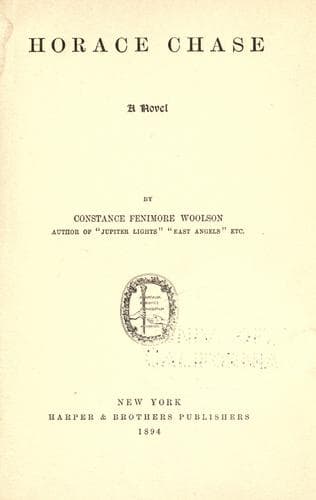
Didactic fiction; Men -- United States -- Fiction; United States -- Social life and customs -- 19th century -- Fiction
The club-room was a large, pleasant apartment, with windows and verandas
overlooking the water. There was a general straightening up of lounging
attitudes when Mrs. Chase came in. Etheridge had already introduced
Horace Chase to everybody at the club, and Chase, in his turn, had
introduced almost everybody to his wife. The club, to a man, admired
Mrs. Chase; while she waited, therefore, she held a little court. The
commodore, meanwhile, kindly took upon himself, as usual, the duty of
entertaining the Bubble.
"Mr. Willoughby need not have gone to the Florida House in person; our
porter could perfectly well have taken a note, as I suggested. Capital
fellow, our porter; I never come South, Mr. Chase, without being struck
afresh with the excellence of the negroes as servants; they are the best
in the world; they're born for it!"
"That's all right, if they're willing," Chase answered. "But not to
force 'em, you know. That slave-market in the Plaza, now--"
"Oh Lord! Slave-market! Have _you_ got hold of that story too?"
interposed Etheridge, irritably. "It was never anything but a
fish-market in its life! But I'm tired of explaining it; that, and the
full-length skeleton hanging by its neck in an iron cage in the
underground dungeon at the fort--if they're not true, they ought to be;
that's what people appear to think! '_Si non ee veero, ee ben
trovatoro_,' as the Italians say. And speaking of the fort, I suppose
you have been to that ridiculous Indian party at Andalusia to-day? Mrs.
Kip must have looked grotesque, out-of-doors? In white too, I dare say?"
"Grotesque? Why, she's pretty," answered Chase.
"Not to my eye," responded Etheridge, determinedly. "She has the facial
outlines of a frog. Do you know the real reason why I didn't marry? I
couldn't endure, sir, the prospect of an old woman's face opposite mine
at table year after year. For our women grow old so soon--"
As he brought this out, a dim remembrance of having said it to Horace
Chase before came into his mind. Had he, or had he not? Chase's face
betrayed nothing. If he had, what the devil did the fellow mean by not
answering naturally, "Yes, you told me?" Could it be possible that he,
Anthony Etheridge, had fallen into a habit of repeating?--So that people
were accustomed--? He went off and pretended to look at a file of
porpoises, who were going out to sea in a long line, like so many fat
dark wheels rolling through the water.
Chase, left alone, took up a newspaper. But almost immediately he threw
it down, saying, "Well, I didn't expect to see _you_ here!"
The person whom he addressed was a stranger, who came in at this moment,
brought by a member of the club. He shook hands with Chase, and they
talked together for a while. Then Chase crossed the room, and, smiling a
little as he noted the semicircle round his wife, he asked her to come
out and walk up and down the pier while they waited for Willoughby. Once
outside, he said:
Public-domain text, read in full here on John Shaqi.
Reviews
Reviews
No reviews yet
Be the first to share your thoughts on this work.
Elsewhere in the archive
Join the Discussion
Join the discussion
Sign in to leave a comment or review.
Sign InorCreate an account