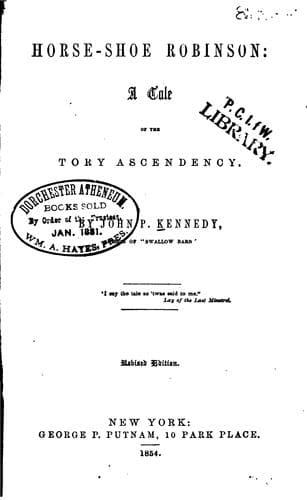
Horse-Shoe Robinson: A Tale of the Tory AscendencyKennedy, John Pendleton
History
Horse-Shoe Robinson: A Tale of the Tory Ascendency
Kennedy, John Pendleton
South Carolina -- History -- Revolution, 1775-1783 -- Fiction
It was the misfortune of South Carolina, during the revolutionary war,
to possess a numerous party less attached to the union or more tainted
with disaffection than the inhabitants of any of the other states.
Amongst her citizens the disinclination to sever from the mother country
was stronger, the spread of republican principles more limited, and the
march of revolution slower, than in either of the other colonies,
except, perhaps, in the neighbor state of Georgia, where the people
residing along the Savannah river, were so closely allied to the
Carolinians in sentiment, habits, and pursuits, as to partake pretty
accurately of the same political prejudices, and to unite themselves in
parties of the same complexion. Upon the first invasion of Georgia, at
the close of the year 1778, the city of Savannah was made an easy
conquest, and a mere handful of men, early in 1779, were enabled to
penetrate the interior as far as Augusta, and to seize upon that post.
The audacity with which Prevost threatened Charleston in the same year,
the facility of his march through South Carolina, and the safety which
attended his retreat, told a sad tale of the supineness of the people of
that province. The reduction of Charleston in the following year, by Sir
Henry Clinton, was followed with singular rapidity by the conquest of
the whole province. A civil government was erected. The most remote
posts in the mountains were at once occupied by British soldiers or
provincial troops, mustered under the officers of the royal army.
Proclamations were issued to call back the wandering sheep to the royal
fold; and they, accordingly, like herds that had been scattered from
beneath the eye of the shepherd by some rough incursion of wolves,
flocked in as soon as they were aware of the retreat of their enemy.
Lord Cornwallis, upon whom the command devolved after the return of Sir
Henry Clinton in June to New York, recruited his army from these
repentant or unwilling republicans; and the people rejoiced at what they
thought the end of strife and the establishment of law. The auxiliaries
who had marched from Virginia and North Carolina under Colonel Buford,
to assist in the defence of the southern capital, were informed of its
surrender as they journeyed thither, and soon found themselves obliged
to fly through a country they had come to succor;--and when even at the
distance of one hundred and fifty miles from the city, were overtaken by
the ruthless troopers of Tarleton, and butchered under circumstances
peculiarly deplorable.
Public-domain text, read in full here on John Shaqi.
Reviews
Reviews
No reviews yet
Be the first to share your thoughts on this work.
Elsewhere in the archive
Join the Discussion
Join the discussion
Sign in to leave a comment or review.
Sign InorCreate an account