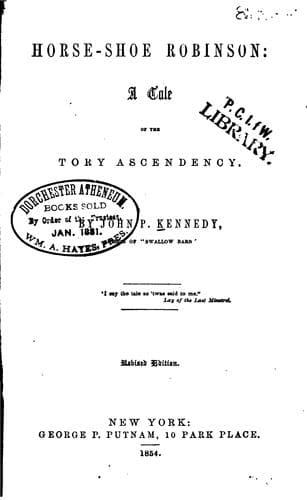
Horse-Shoe Robinson: A Tale of the Tory AscendencyKennedy, John Pendleton
History
Horse-Shoe Robinson: A Tale of the Tory Ascendency
Kennedy, John Pendleton
South Carolina -- History -- Revolution, 1775-1783 -- Fiction
One feature that belonged to this unhappy state of things in Carolina
was the division of families. Kindred were arrayed against each other in
deadly feuds, and, not unfrequently, brother took up arms against
brother, and sons against their sires. A prevailing spirit of treachery
and distrust marked the times. Strangers did not know how far they might
trust to the rites of hospitality; and many a man laid his head upon his
pillow, uncertain whether his fellow lodger, or he with whom he had
broken bread at his last meal, might not invade him in the secret
watches of the night and murder him in his slumbers. All went armed, and
many slept with pistols or daggers under their pillows. There are tales
told of men being summoned to their doors or windows at midnight by the
blaze of their farm-yards to which the incendiary torch had been
applied, and shot down, in the light of the conflagration, by a
concealed hand. Families were obliged to betake themselves to the
shelter of the thickets and swamps, when their own homesteads were
dangerous places. The enemy wore no colors, and was not to be
distinguished from friends either by outward guise or speech. Nothing
could be more revolting than to see the symbols of peace thus misleading
the confident into the toils of war; nor is it possible to imagine a
state of society characterized by a more frightful insecurity.
Such was the condition of the country to which my tale now makes it
necessary to introduce my reader. Butler's instructions required that
he should report himself to General Gates, and, unless detained for more
pressing duty, to proceed with all the circumspection which the
enterprise might require, to Colonel Clarke, who, it was known, was at
that time in the upland country of South Carolina, raising troops to act
against Augusta and other British posts. He accordingly arrived at
head-quarters, on the borders of the two Carolinas, in about a week
after leaving the Dove Cote. The army of the brave and unfortunate De
Kalb, which had been originally destined for the relief of Charleston,
had been increased, by reinforcements of militia from Virginia and the
adjoining States, to double the computed strength of the British forces;
and Gates, on taking command of it, was filled with the most lofty
presentiments of victory. Vainglorious and unadvisable, he is said to
have pushed forward with an indiscreet haste, and to have thrown himself
into difficulties which a wiser man would have avoided. He professed
himself to stand in no need of recruits to his army, and Butler,
therefore, after the delay of a few days, was left at liberty to pursue
his original scheme.
Public-domain text, read in full here on John Shaqi.
Reviews
Reviews
No reviews yet
Be the first to share your thoughts on this work.
Elsewhere in the archive
Join the Discussion
Join the discussion
Sign in to leave a comment or review.
Sign InorCreate an account