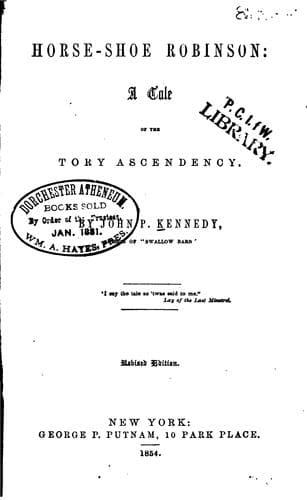
Horse-Shoe Robinson: A Tale of the Tory AscendencyKennedy, John Pendleton
History
Horse-Shoe Robinson: A Tale of the Tory Ascendency
Kennedy, John Pendleton
South Carolina -- History -- Revolution, 1775-1783 -- Fiction
that, with all the joyousness of health, encompassed this blighted spot.
Its aspect was one of unpleasant desolation; and the traveller of the
present day who visits our western wilds, where this slovenly practice
is still in use, will never pass through such a precinct without a sense
of disgust at the disfiguration of the landscape.
The field thus marred might have contained some fifty acres, and it was
now occupied, in the intervals between the lifeless trunks, with a
feeble crop of Indian corn, whose husky and parched blades, as they
fluttered in the evening wind, added new and appropriate features to the
inexpressible raggedness of the scene. The same effect was further aided
and preserved by the cumbrous and unseemly worm fence that shot forth
its stiff angles around the tract.
On the very apex of the hill up which our travellers were now
clambering, was an inclosure of some three or four acres of land, in the
middle of which, under the shade of a tuft of trees, stood a group of
log cabins so situated as to command a view, of nearly every part of the
farm. The principal structure was supplied with a rude porch that
covered three of its sides; whilst the smoke that curled upwards from a
wide-mouthed chimney, and the accompaniment of a bevy of little negroes
that were seen scattered amongst the out-houses, gave an air of
habitation and life to the place that contrasted well with the
stillness of the neighboring wood. A well-beaten path led into a narrow
ravine where might be discerned, peeping forth from the weeds, the roof
of a spring house; and, in the same neighborhood, a rough garden was
observable, in which a bed of broad-leaved cabbages seemed to have their
ground disputed by a plentiful crop of burdock, thistles, and other
intruders upon a manured soil. In this inclosure, also, the hollyhock
and sunflower, rival coxcombs of the vegetable community, gave their
broad and garish tribute to the beautifying of the spot.
The road approached within some fifty paces of the front of the cabins,
where access was allowed, not by the help of a gate, but only by a kind
of ladder or stile formed of rails, which were so arranged as to furnish
steps across the barrier of the worm fence at four or five feet from the
ground.
"Are you sure of entertainment here, Galbraith?" inquired Butler, as
they halted at the stile. "This Wat Adair is not likely to be churlish,
I hope?"
"I don't think I am in much humor to be turned away," replied Robinson.
"It's my opinion that a man who has rode a whole day has a sort of right
to quarters wherever the night finds him--providing he pays for what he
gets. But I have no doubt of Wat, Major. Holloa! who's at home? Wat
Adair! Wat Adair! Travellers, man! Show yourself."
"Who are you that keep such a racket at the fence there?" demanded a
female voice. "What do you mean by such doings before a peaceable
house?"
Public-domain text, read in full here on John Shaqi.
Reviews
Reviews
No reviews yet
Be the first to share your thoughts on this work.
Elsewhere in the archive
Join the Discussion
Join the discussion
Sign in to leave a comment or review.
Sign InorCreate an account