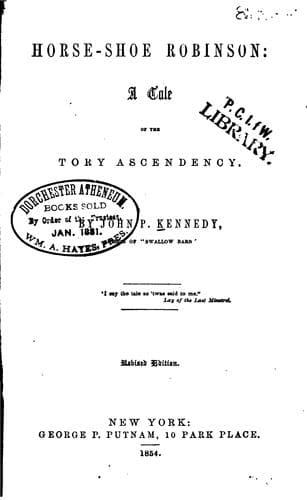
Horse-Shoe Robinson: A Tale of the Tory AscendencyKennedy, John Pendleton
History
Horse-Shoe Robinson: A Tale of the Tory Ascendency
Kennedy, John Pendleton
South Carolina -- History -- Revolution, 1775-1783 -- Fiction
"Well-a-day, I see how it is!" muttered the grandmother in an accent of
reproof, "that's the way of the world. Love is like a running river, it
goes downwards, but doesn't come back to the spring. The poor old granny
in the chimney corner is a withered tree up the stream, and the youngest
born is a pretty flower on the bank below. Love leaves the old tree and
goes to the flower. It went from me to Peggy's mother, and so downwards
and downwards, but it never will come back again. The old granny's room
is more wanted than her company; she ought to be nailed up in her coffin
and put to sleep down, down in the cold ground. Well, well! But Watty's
a proud wretch, that's for certain!"
In this strain the aged dame continued to pour forth a stream of
garrulity exhibiting a mixture of the silly dreamings of dotage, with a
curious remainder of the scraps and saws of former experience--a strange
compound of futile drivelling and shrewd and quick sagacity.
During the period of the foregoing dialogue, preparations were making
for supper. These were conducted principally under the superintendence
of our Hebe, who, my reader will recollect, some time since escaped from
the room, and who, as Butler learned, in the course of the evening, was
a niece of Adair's wife and bore the kindly name of Mary Musgrove. The
part which she took in the concerns of the family was in accordance with
the simple manners of the time, and such as might be expected from her
relationship. She was now seen arranging a broad table, and directing
the domestics in the disposition of sundry dishes of venison, bacon, and
corn bread, with such other items of fare as belonged to the sequestered
and forest-bound region in which Adair resided.
Mary was frequently caught directing her regards towards Butler, whose
face was handsome enough to have rendered such a thing quite natural
from a young girl: but she seemed to be moved by more than ordinary
interest, as the closeness of her scrutiny almost implied a suspicion in
her mind of his disguise. In truth there was some incongruity between
his manners and the peasant dress he wore, which an eye like Mary's
might have detected, notwithstanding the plainness of demeanor which
Butler studied to assume.
"We have nothing but corn bread in the house," said Mary in a low tone
to her kinswoman, "perhaps the gentlemen (here she directed her eye, for
the fiftieth time, to Butler) expected to get wheat. Had I not better
pull some roasting-ears from the garden and prepare them? they will not
be amiss with our milk and butter."
"Bless you, my dear," said Butler, thrown completely off his guard, and
showing more gallantry than belonged to the station he affected. "Give
yourself no trouble on my account; we can eat anything. I delight in
corn cakes, and will do ample justice to this savory venison. Pray do
not concern yourself for us."
"It is easy as running to the garden," said Mary in a sweet and almost
laughing tone.
Public-domain text, read in full here on John Shaqi.
Reviews
Reviews
No reviews yet
Be the first to share your thoughts on this work.
Elsewhere in the archive
Join the Discussion
Join the discussion
Sign in to leave a comment or review.
Sign InorCreate an account