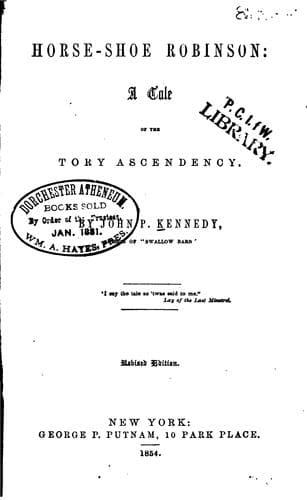
Horse-Shoe Robinson: A Tale of the Tory AscendencyKennedy, John Pendleton
History
Horse-Shoe Robinson: A Tale of the Tory Ascendency
Kennedy, John Pendleton
South Carolina -- History -- Revolution, 1775-1783 -- Fiction
Butler carefully interrogated the maiden as to all the particulars of
his visit, and she, with the most scrupulous fidelity, recounted the
scenes to which she had been a witness. When she came to detail the
conversation which she had overheard between Adair and Lynch, and the
events that followed it, the interest of the bystanders was wound up to
the highest pitch. There was a simplicity in her recital of this strange
and eventful story, that gave it a force to which the most skilful
eloquence might in vain aspire; and when she concluded, the court
itself, prejudiced as the members were against the prisoner, could not
help manifesting an emotion of satisfaction at the clear and unequivocal
refutation which this plain tale inferred against the testimony of
Habershaw and his confederates. Innis alone affected to treat it
lightly, and endeavored in some degree to abate its edge, by suggesting
doubts as to the capacity of a young girl, in circumstance so likely to
confuse her, to give an exact narrative of such a complicated train of
events. Every cross-examination, however, which was directed to the
accuracy of the maiden's story, only resulted in producing a stronger
conviction of its entire truth. This concluded the examination on the
second charge.
The court now proceeded to the third and last accusation against the
prisoner.
To this there was but one witness called--James Curry. In the course of
the examination this man showed great address and knowledge of the
world. He gave some short account of himself. He had been a man born to
a better condition of life than he now enjoyed. His education had been
liberal, and his associations in life extremely various. It was to be
inferred from his own relation, that he had fallen into some early
indiscretion which had thrown him into the lowest stations of society,
and that his original delinquency had prevented him from ever rising
above them. He had served for many years in the army, and was present at
the surrender of Charleston, being at that period a confidential
servant, or man of business, to the young Earl of Caithness, the
aide-de-camp of Sir Henry Clinton. Upon the departure of that young
nobleman with the rest of Sir Henry's military family, for New York, he
had remained behind, and had taken a similar service to that which he
had left, with another officer of some repute. "There were state
reasons," he said, "why this gentleman's name could not now be
communicated to the court." That, in the month of July, he had attended
his master on a visit to Mr. Philip Lindsay, in Virginia; and whilst in
the immediate vicinity of that gentleman's residence, at a small country
tavern, he had accidentally become privy to the design of the prisoner,
and the same Horse Shoe Robinson who had been mentioned before, to seize
upon the person and papers of Mr. Lindsay: that these two persons had
actually arrived at the tavern he spoke of to commence operations. That
Public-domain text, read in full here on John Shaqi.
Reviews
Reviews
No reviews yet
Be the first to share your thoughts on this work.
Elsewhere in the archive
Join the Discussion
Join the discussion
Sign in to leave a comment or review.
Sign InorCreate an account