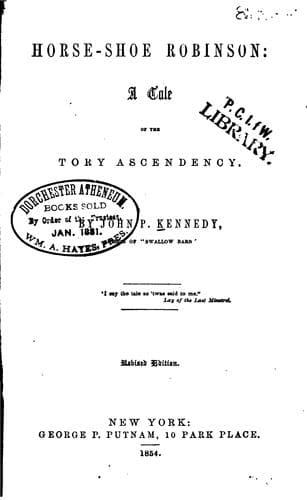
Horse-Shoe Robinson: A Tale of the Tory AscendencyKennedy, John Pendleton
History
Horse-Shoe Robinson: A Tale of the Tory Ascendency
Kennedy, John Pendleton
South Carolina -- History -- Revolution, 1775-1783 -- Fiction
"The last charge against you is fully proved. Not a word of counter
evidence has been offered. Strictly speaking, by the usages of war, this
would not be an offence for the notice of a military tribunal. The
perpetrators of it would be liable to such vindictive measures as the
policy of the conqueror might choose to adopt. That we have given you,
therefore, the benefit of an inquiry, you must regard as an act of
grace, springing out of our sincere desire to do you ample justice. The
nature of the offence imputed and proved is such as, at this moment,
every consideration of expediency demands should be visited with
exemplary punishment. The friends of the royal cause, wherever they may
reside, shall be protected from the wrath of the rebel government; and
we have, therefore, no scruple in saying, that the attempt upon the
person of Mr. Philip Lindsay requires a signal retribution. But for this
last act, the court might have been induced to overlook all your other
trespasses. Upon this, however, there is no hesitation.
"Such being the state of the facts ascertained by this tribunal, its
function ceases with its certificate of the truth of what has been
proved before it. The rest remains to me. Without the form of an
investigation, I might, as the commanding officer of a corps on detached
service, and by virtue of special power conferred upon me, have made up
a private judgment in the case. I have forborne to do that, until, by
the sanction of a verdict of my comrades, I might assure myself that I
acted on the clearest proofs. These have been rendered.
"My order, therefore, is, in accordance with the clear decision of the
court,--and, speaking to a soldier, I use no unnecessary phrase of
condolence,--that you be shot to death. Time presses on us and forbids
delay. You will be conducted to immediate execution. Major Frazer," he
said, turning to one of his officers, "to your discretion I commit this
unpleasant duty." Then, in a tone of private direction, he added, "Let
it be done without delay; pomp and ceremony are out of place in such a
matter. I wish to have it despatched at once."
"I would speak," said Butler, repressing the agitation of his feelings,
and addressing Innis with a stern solemnity, "not to implore your mercy,
nor to deprecate your sentence: even if I could stoop to such an act of
submission, I know my appeal would reach your ears like the idle wind:
but I have private affairs to speak of."
"They were better untold, sir," interrupted Innis with an affected air
of indifference. "I can listen to nothing now. We have other business to
think of. These last requests and settlements of private affairs are
always troublesome," he muttered in a tone just audible to the officers
standing near him; "they conjure up useless sympathies."
"I pray you, sir," interposed St. Jermyn.
Public-domain text, read in full here on John Shaqi.
Reviews
Reviews
No reviews yet
Be the first to share your thoughts on this work.
Elsewhere in the archive
Join the Discussion
Join the discussion
Sign in to leave a comment or review.
Sign InorCreate an account