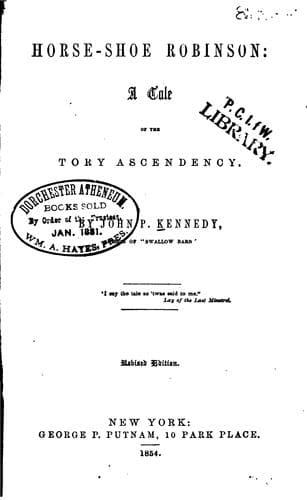
Horse-Shoe Robinson: A Tale of the Tory AscendencyKennedy, John Pendleton
History
Horse-Shoe Robinson: A Tale of the Tory Ascendency
Kennedy, John Pendleton
South Carolina -- History -- Revolution, 1775-1783 -- Fiction
Agitated with a thousand doubts, his mind was too busy to permit him to
close his eyes during the night that followed; and in this wakeful
suspense he could sometimes hear, amongst the occasional ramblers who
passed under his window, an allusion, in their conversation, to a
victory gained over the royal troops. Coupling this with the name of
Sumpter, which was now and then uttered with some adjective of
disparagement, he conjectured that Horse Shoe had probably fallen in
with that partisan, and was, peradventure, leading him to this vicinity.
But this conclusion was combated by the fact that there seemed to be no
alarm in the camp, nor any preparations on foot either for instant
battle or retreat. Then the letter--that was a mystery altogether
impenetrable. There was only one point upon which his mind could rest
with satisfaction: of that he was sure--Horse Shoe was certainly at the
bottom of the scheme, and was active in his behalf.
The whole of the next day passed over in the same state of uncertainty.
It was observed by Butler, with some stress upon the circumstance, that
Captain St. Jermyn, who had heretofore evinced a disposition to make
himself busy in his behalf, had absented himself ever since the trial;
and he thus felt himself cut off from the slightest exhibition of
sympathy on the part of a single individual in the multitude of fellow
beings near him. Indeed, there were various indications of a general
personal ill-will against him. The house, in which he was confined, was
so constructed that he could frequently hear such expressions, in the
conferences of those who inhabited the rooms below stairs, as were
uttered above the lower key of conversation, and these boded him no
good. Once, during the day, Colonel Innis visited him. This officer's
countenance was severe, and indicated anger. His purpose was to extort
something from the prisoner in reference to his supposed knowledge of
the course of operations of Sumpter, from whose camp Innis did not doubt
this letter regarding St. Jermyn had come. He spoke in a short, quick,
and peremptory tone:
"It may be well for you," he said, "that your friends do not too rashly
brave my authority. Let me advise you to warn them that others may fall
into our hands; and that if the ensign be not delivered up, there may be
a dreadful retaliation."
Public-domain text, read in full here on John Shaqi.
Reviews
Reviews
No reviews yet
Be the first to share your thoughts on this work.
Elsewhere in the archive
Join the Discussion
Join the discussion
Sign in to leave a comment or review.
Sign InorCreate an account