On one occasion it was my privilege to assemble seventy horsemen
whose united experience of the stock-range covered the grass lands of
Asia from Mongolia to Hungary, Eastern and Southern Africa, all
states of Australasia, Patagonia, the Argentine, the Llano, and every
state and province of the open pasture in Mexico, the United States
and Canada. Among us we compiled a brief text defining our ideas of
range as distinguished from civilised horsemanship. The text was
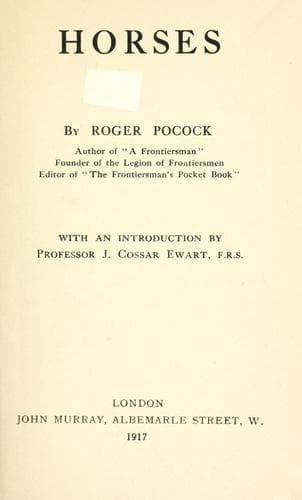
printed as a chapter on "The Horse" in "The Frontiersman's Pocket
Book" (John Murray), which I compiled and edited on behalf of the
Legion of Frontiersmen. The present volume {178} is merely an
application of these range principles to the study of horses and
horsemanship.
The pretension of range horsemen as a class is to earn a living by
the use of cheap working horses, riding with a weight-distributing
equipment and pack transport, while we base our mobility upon a herd
of remounts.
[Sidenote: Pleasure horsemanship]
For pleasure horsemanship our feeling is one of admiring envy. No
men are better able to appreciate the incomparable gallantry and elan
of the hunting field, especially in Ireland, the beautiful spectacles
afforded by racing, horse shows, and tournaments, the grand pageantry
of state functions in European capitals. Even such pretty futilities
as Portuguese bull-baiting and the Haut Ecole of France appeal to us
as horsemen. As to military horsemanship we have an unbounded
admiration for the fine driving of the Royal Horse Artillery, and the
obstacle riding of the Mexican Regular Cavalry. On the other hand we
are not stricken with awe at the circus tricks of the Cossack,
although we may be surprised to see a luggage strap used for girth.
Nor are we emulous of the horse-killing man-endurance rides which
used to be considered good sport by European cavalry. We can do the
little circus tricks ourselves, {179} and make our endurance rides
without killing our horses.
[Sidenote: Horsemanship]
Among ourselves we are more critical. The Mexican ranchero for
example wears a revolver on the belt, a sword on the saddle, a silver
bridle, a suit of leather beautifully laced with gold or silver, and
a most prodigious hat. But do these fine feathers make him a fine
bird? Or is the prancing arch-necked horse made sprightly by pinched
shoes and a spade bitt?
By contrast the Boer is the most slovenly of horsemen, both in his
old slop suit and in his flapping gait, but in scouting and fighting
by far the best instructor we ever met, and either as enemy or friend
we love his manhood. If horsemanship is an expression of manhood, we
do not mind the form if we can get the fact. More manhood goes to
the making of one Boer than to a hundred Mexicans.
Searching for the elements distinctive of range horsemanship, as
contrasted with the pleasure, the military and the working
horsemanship of civilization, a few essential things come clearly
into view.
Public-domain text, read in full here on John Shaqi.
Reviews
Reviews
No reviews yet
Be the first to share your thoughts on this work.
Elsewhere in the archive
Join the Discussion
Join the discussion
Sign in to leave a comment or review.
Sign InorCreate an account