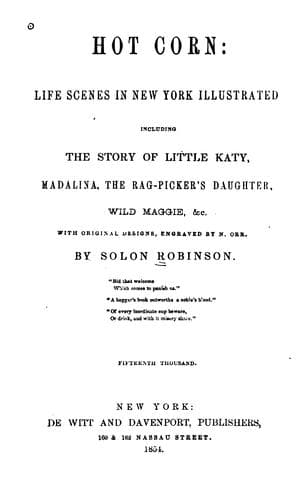
Hot corn: Life Scenes in New York IllustratedRobinson, Solon
General
Hot corn: Life Scenes in New York Illustrated
Robinson, Solon
New York (N.Y.) -- Social life and customs -- 19th century -- Fiction; Temperance -- Fiction
Walter and she had had "a good time" together, and parted lovingly only
a few hours before. How he was surprised as he entered her room
carelessly, to hear her tell him with a terrible oath--oaths are ten
times more terrible in woman's than in man's mouth--to leave the room or
she would take his life. At first, he thought she was in sport. One look
was enough to convince him of his error. Then he thought she was mad,
because he had entered without knocking, and found her engaged in
dressing for the evening debauch and usual scenes of dissipation, and
began to rally her on her Eve-like appearance.
That was more than some more amiable women can bear. No matter how ill
dressed or undressed, a woman does not like to be rallied on her
personal appearance.
It was more than such a human tiger could, or would bear. She darted at
him, and proceeded vigorously in the task of reducing him to the same
state, so far as his toilet was concerned, as herself. It did not take
long. First, she crushed his hat. His dress coat was fine, and it was
tender, for it was old, and she tore it into ribbons, in an instant. His
vest and shirt followed, and she made vigorous efforts at the remaining
garment, and then he broke and ran from the wild fury. She overtook him
at the top of the stairs, gave him a vigorous kick that sent him, naked
and insensible, down to the lower hall, where he was picked up by the
police, and carried to the station house; there he had his bruises
attended to, and there he would have got a passport to "the Island,"
only that he happened to be known, and when he told where he lived, one
of the officers said, that was the fact, that he knew his wife, and a
most excellent woman she was, and it would be a pity, on her account, to
send him up this time, and so he volunteered to go home with him, and
get some clothes and see what his wife wanted done with him. Walter
found his trunk and all that he could claim as his own--it was not much,
hardly enough for present necessity--where Athalia had left it, in the
next-door shop, and there he learned the facts about the sale, and his
wife going off in a carriage with two ladies, and a Negro driver; but he
did not learn why she had gone, he needed no words to tell him that, a
monitor within spoke louder than words.
"A guilty conscience needs no accuser."
What should he do? It is easy to say what a man should do. He should go
and find his wife, and fall down upon his knees; yes, bow his face into
the dust, pray for forgiveness, and promise reform. And he would be
forgiven. That is woman's nature. The Forgiver of all sins, is not more
forgiving.
"What did he do?"
That is just as easy said. He sold his last good shirt--one that his
wife had just made--to procure the means of getting drunk.
"What a pity that there should be any places where such a man could get
liquor; or that such places, if they do exist, should be kept by
wretches who will take the shirt off the back of the poor inebriate for
rum."
Public-domain text, read in full here on John Shaqi.
Reviews
Reviews
No reviews yet
Be the first to share your thoughts on this work.
Elsewhere in the archive
Join the Discussion
Join the discussion
Sign in to leave a comment or review.
Sign InorCreate an account