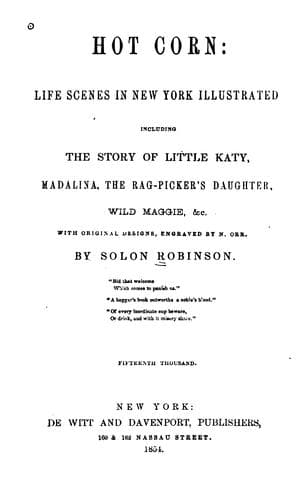
Hot corn: Life Scenes in New York IllustratedRobinson, Solon
General
Hot corn: Life Scenes in New York Illustrated
Robinson, Solon
New York (N.Y.) -- Social life and customs -- 19th century -- Fiction; Temperance -- Fiction
I have a little incident to relate of a girl lost. A few years ago No.
000 Church street, was accounted the "luckiest house in the street."
There are a great many unlucky ones in that street now, and that
particular one is esteemed the most unlucky of all of them. It should be
so. It was in that house about three years ago, that a girl was lost.
For the sake of her parents, brothers and sisters, and large family of
relatives, I will not give her true name. You may call it Julia
Montgomery. She was just such a girl as the one described in the
"Mysterious Disappearance!" She was tall and handsome, just seventeen,
with dark hair and eyes, and well dressed. She lived in one of the river
towns, and came down upon one of the barges that float down such a
multitude of things produced by farmers, in company with her father and
mother, who brought some of their own produce to market. On the same
boat were two young men who had been up the river, they said, on a
sporting excursion. This was true. But they might have added, "What is
sport to us is death to you." They were gamblers. On the passage they
made the acquaintance of Julia, and by their bland manners completely
won the confidence of the old folks. When they arrived, they were very
anxious that Julia should go home with them and see their sisters. They
were not so anxious that her mother should go, but they insisted very
hard that she should, because they knew she would not; she had her
butter and eggs and chickens to sell, and lots of shopping to do, so
Julia went alone. She came back to the boat towards night to tell her
mother what nice girls the Miss Camptowns were, and that they wanted she
should go with them to the theatre, and then as it would be late, stay
all night. The mother consented, as Mr. Camptown was such a fine young
man. After the play they had an oyster supper and wine, and Julia became
very much elated. Then they went home, to Mr. Camptown's home, which was
no other than that notorious Church street den, and the "sisters" the
most notorious sinners in it. Of course more wine was drank, and Julia
became oblivious of what transpired. She waked to consciousness next
morning to find herself--"a girl lost." Almost delirious, she flew from
the wicked scoundrel at her side to the street door, to find it barred
against her. In vain she begged and prayed, and cried to be let out. The
soul incarcerated in the infernal regions might as well pray for egress.
She finds in both cases only scoffing at the victim's agony. Then she
grew wildly furious, and then they tied her hands and feet and carried
her down into the coal cellar, "to let her get over her fit, and keep
her out of sight till the old woman was out of the way." For three days,
Camptown watched her father and mother, and then they gave up and went
home with heavy hearts, for "a girl was lost." Yes, she was "lost." Then
Camptown went back to enjoy his "country beauty." She was lost to him
also.
Public-domain text, read in full here on John Shaqi.
Reviews
Reviews
No reviews yet
Be the first to share your thoughts on this work.
Elsewhere in the archive
Join the Discussion
Join the discussion
Sign in to leave a comment or review.
Sign InorCreate an account