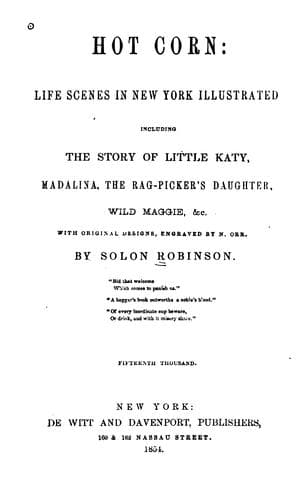
Hot corn: Life Scenes in New York IllustratedRobinson, Solon
General
Hot corn: Life Scenes in New York Illustrated
Robinson, Solon
New York (N.Y.) -- Social life and customs -- 19th century -- Fiction; Temperance -- Fiction
"How could she? How could a mother be so wicked to her poor sick child?
I am sure if I could not take care of mine, I would trust it with
anybody who would save its life." Thus will say more than one Christian
mother.
Think--be careful--be not uncharitable--good mother. Would you let it go
with those who saved its life to be reared with them--taught their
creed--perhaps to hate yours? Certainly if taught the principles of
temperance--virtue--neatness--her child could not love its drunken
mother, in her rags and dirt and life of sin.
"But then the child would be brought up by religious teachers, and
taught to be a Christian."
Yes, a Protestant Christian; she is a good Catholic. Would you willingly
give up your child if it were to be reared a Pagan, a Mahometan, or even
a Jew?
"No! I would let it die."
There spoke the Five Points mother. Sooner than it should go into a
Protestant house, she would see it die.
Alas! poor human nature; yes, poor human nature, sunk down into those
depths of misery and degradation, yet every one of them are our brothers
and sisters, who are rearing up children like themselves, as true as
like produces like, while we look on, shrug our comfortably-wrapped
shoulders, and "Thank God we are not like one of these," and yet never
give, out of our abundance, one cent to make one of them like one of us.
"Well, what of her husband?"
"My husband, is it?" she said, as she stood glaring at us; "my husband?
Go, look in your city prison, you old gray-headed villains, where ye or
the likes of ye, murdered him without judge or jury. Did you try him for
his life? No. Had he been a murderer? No. Had he done any crime? No. You
licensed him to sell liquor, and he drank too much--I drank too
much--what else can you expect, when you set fools to play with live
coals, but they will burn themselves? What next? What is the natural
consequence of getting drunk? A quarrel. I know it. Don't ask me what I
get drunk for; I know you did not speak, but I saw it in your eye--yes,
your eye--turn it away--I cannot bear it, it looks right into my soul.
Don't look at me that way, or I shall cry, and I had rather die than do
that. It would kill me to cry for such as you, who murdered my poor
husband. You licensed him to sell rum, in the first place, to make other
wives miserable with drunken husbands--mine was not drunken then, and I
did not have to live in such a hole as this--look around you, ye
murdering villains. What do you see?--poverty, filth, and rags;
starvation, misery, crime--on that bed is my dying boy--that is nothing.
Let him die, I am glad of it--the priest has made it all right with him.
Now, look in that bed, rum-selling, licensing whelps that you are--that
is worse than the dying boy in the other--see what we have bought with
our money paid to your excise office. See what a mother is sunk to by
rum. Yes, I do drink it--why do your eyes ask the question? I do drink,
and will again.
Public-domain text, read in full here on John Shaqi.
Reviews
Reviews
No reviews yet
Be the first to share your thoughts on this work.
Elsewhere in the archive
Join the Discussion
Join the discussion
Sign in to leave a comment or review.
Sign InorCreate an account