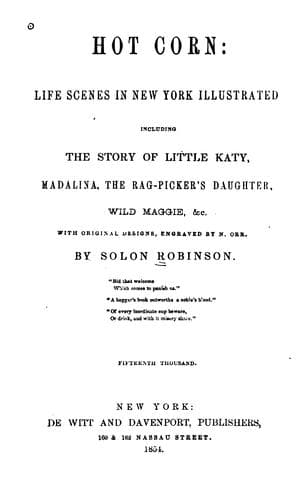
Hot corn: Life Scenes in New York IllustratedRobinson, Solon
General
Hot corn: Life Scenes in New York Illustrated
Robinson, Solon
New York (N.Y.) -- Social life and customs -- 19th century -- Fiction; Temperance -- Fiction
"Why, my dear girl, there are a hundred men, editors, reporters,
compositors, pressmen, book-keepers, and all, in that office; now, how
are you going to find one that you do not know, and say you have
forgotten his name?"
"May be I shall recollect it when I get there. Don't you know how names
come back to us sometimes? Do you never forget names?"
"Often, but I never forget faces. I have seen yours before, but I have
forgotten where, just as you have forgotten that gentleman's name."
"Oh, sir, have you? well, I do not remember your face, but it does seem
as though I had heard your voice, and, perhaps, if the room was not so
dark, I should know you. The lady said, I must keep it dark, and sleep
this morning. It is no wonder that I should forget everything, I was so
badly frightened last night."
"Well, I don't see how you are to find which one you wish to see, among
so many, unless you can recollect his name."
"Oh, that will be easy enough, sir. I will ask one of the gentlemen. I
am sure any one of them will tell me, for I am sure they are all
gentlemen, real gentlemen."
"I do not see what it is that you are to inquire for, or who, or now to
find, out which one, or anything about it."
"Oh, sir, it is the one that wrote that little story about her
daughter."
"Her daughter?"
"Yes, sir, Mrs. De Vrai's daughter."
A light began to dawn in my mind, and I said carelessly, "her daughter?"
"Yes, sir, her daughter. Little Katy, in that pretty story of Hot Corn.
She is Little Katy's mother, sir, and she wants to see the gentleman
that wrote that story. She did not know his name until yesterday. She
thought it was Mr. Greeley, and he was out of town, and she had never
seen him since Little Katy was buried, and she had moved away from where
she used to live, without letting him know where she was. Yesterday she
found out her mistake, and sent Phebe--you laugh--do you know Phebe?"
"Yes, yes, I know Phebe, and I know you now; I know you for a
kind-hearted, good-natured girl. Your name is Agnes."
"Oh, yes, sir, has Mrs. Morgan told you."
Now the reader is surprised. Yes, it is Mrs. Morgan--Athalia. It was she
that faced the crowd of savages that cried "drag her out." It was she
that took poor Agnes in and gave up her own bed, and nursed and watched
her all night, and sent for a physician for her. It was Agnes, the girl
that you have seen in the picture with the negro wood-sawyer, and at his
home when Phebe divided her bed to give the poor girl a lodging. There
is some goodness yet in human nature. It was Phebe that Agnes went to
see, while nursing Mrs. De Vrai. It was the latter for whom she was now
so anxious to get up out of her sick bed, that she might go and tell the
gentleman who wrote the story of "Little Katy," that Little Katy's
mother was almost dying to see him. It was by that token that she would
find him.
"Did Mrs. Morgan tell you my name."
"No, she has not told me; you told me that a long time ago."
"Me, sir? Do you know me, sir?"
Public-domain text, read in full here on John Shaqi.
Reviews
Reviews
No reviews yet
Be the first to share your thoughts on this work.
Elsewhere in the archive
Join the Discussion
Join the discussion
Sign in to leave a comment or review.
Sign InorCreate an account