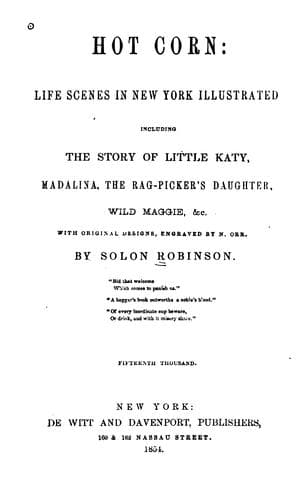
Hot corn: Life Scenes in New York IllustratedRobinson, Solon
General
Hot corn: Life Scenes in New York Illustrated
Robinson, Solon
New York (N.Y.) -- Social life and customs -- 19th century -- Fiction; Temperance -- Fiction
"Well, I don't understand why, but I suppose I might as well proceed.
'Tell her,' said he, 'that he is well known and easily found, and that I
left the child with him, telling him that it was mine, and that its
mother was dead.' Then I was a little surprised, for I thought his name
was De Vrai, 'but that,' he said, 'was an assumed one, the name by
which he married the woman that I knew, because he dared not marry her
by his own name. Then, I asked him what was her name, who I should look
for, and who she should inquire for, to find her child? Then he took a
little card out of his pocket, as though he would write her name, and
then he seemed to recollect his broken arm, and said, with a groan, 'my
writing days are over, and all my days nearly.' Then, he told me, to
take the card and write, and so I did, here it is--'this is the mother's
name, and this is her daughter's, upon the truth of a dying man--tell
her so, beg her to forgive and forget the dead.'"
"What are the names? Do tell us, uncle."
"Mrs. Meltrand--Agnes Brentnall."
Now there were at least two screams and one, "Oh how wonderful!"
Then Agnes said, "Mrs. Meltrand my mother!--that is wonderful!"
Then Mr. Lovetree looked surprised; all around him seemed to be a mass
of mystery. Others began to see through it, he was now in the dark.
Athalia explained. There was one point that she was not quite clear
upon, and she asked her uncle if Agnes was really De Vrai's daughter, or
only Mrs. Meltrand's?
"His own. Mrs. Meltrand, was his lawful wife when he married Mrs. De
Vrai."
"Oh my God! then Agnes is his own child."
None spoke--what each thought sent a thrill of icy horror to every
heart. All groaned or wept, none could speak. There are moments in life
of speechless agony, when the mind is completely horrified, when
anything that breaks the silence comes as a relief. It came now in the
sound of the door bell. It was a messenger to Mr. Lovetree. It brought
relief to aching minds. It was very short. It only said, "he is dead."
It is perhaps wrong to rejoice at the death of a fellow creature, but we
could not feel regret.
After the first flush of excitement was over, a note was written to
Agnes's mother, simply stating that if she would call at Mrs. Morgan's
at her earliest convenience, she would meet with an individual who could
tell her of her long-lost daughter. She made it convenient to come
immediately, though it was then ten o'clock at night.
It is not reasonable to suppose that she could keep away till morning,
particularly as she had heard a word or two at her first visit which
left her mind uneasy.
I drop the curtain upon the scene when the mother acknowledges and
receives to her arms her long-lost daughter, while I go to carry comfort
to the heart of Mrs. De Vrai, the ill-treated wife--the widow of a
villain--the mother of his child, soon to be an orphan.
What a load it lifted from her crushed heart, when I told her those
three little words--"he is dead."
Public-domain text, read in full here on John Shaqi.
Reviews
Reviews
No reviews yet
Be the first to share your thoughts on this work.
Elsewhere in the archive
Join the Discussion
Join the discussion
Sign in to leave a comment or review.
Sign InorCreate an account