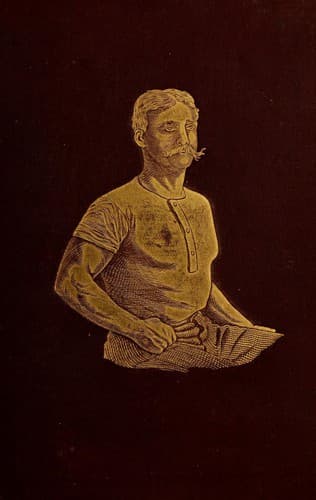
How to Get Strong and How to Stay SoBlaikie, William
Science
How to Get Strong and How to Stay So
Blaikie, William
Physical education and training
Before leaving the waist, there is one more set of muscles which demand
attention; and if one has them weak, no matter how strong he may be
elsewhere, he is weak in a place where he can ill afford to be, and that
is in the loins, or the main muscles in the small of the back, running
up and down at each side of the spine. In many of the heavier grades of
manual labor these muscles have a large share of work to do. All
stooping over, when lifting is done with a spade, or fork, or bar,
whether the knees are held straight or bent, or lifting any weight
directly in the hands, horizontal pulling on a pulley-weight, rope, or
oar--in short, nearly every sort of work where the back is actively
employed, keeps these muscles thoroughly active. You cannot bend over
without using them. Weed awhile, and, unless already strong in the
loins, they will ache.
A laboring man weak here would hardly be worth hiring. A rowing-man
weak here could never be a first-rate oar till he had trained away
the weakness. Heenan, with all his grand physique, his tremendous
striking-power, his massive development above the waist, would not
have made nearly as enduring an oar as the sturdier, barrel-chested
Morrissey, or as the broad-loined Renforth did make. Strong loins
are always desirable. He who has them, and is called on in any sudden
emergency to lift any heavy weight, as the prostrate form of one
who has fallen in a swoon, for instance, is far less likely to work
himself serious, if not permanent, injury here than he who has them
untrained and undeveloped.
_Development above the Waist._
Little or no work has been suggested, so far, aimed purposely to develop
any muscles above the waist. Indeed, it is no uncommon thing, especially
among Englishmen, to find a man of very strong legs and waist, yet with
but an indifferent chest and shoulders, and positively poor arms. Canon
Kingsley had discovered this when he said to the British clergy, "I
should be ashamed of being weak. I could not do half the little good
I do here if it were not for that strength and activity which some
consider coarse and degrading. Many clergymen would half kill
themselves if they did what I do. And though they might walk about
as much, they would neglect exercise of the arms and chest, and
become dyspeptic or consumptive."
Let us look at a few things which would have proved useful to the brave
canon's pupils. The connection between the arms and the muscles, both on
the front and back of the chest, is so close that it is practically
impossible to have arms thoroughly developed, and not have all the trunk
muscles above the waist equally so. Fortunately, as in foot-work, the
exercises to develop these muscles, without having to resort to
expensive apparatus, or often to any at all, are very numerous.
Public-domain text, read in full here on John Shaqi.
Reviews
Reviews
No reviews yet
Be the first to share your thoughts on this work.
Elsewhere in the archive
Join the Discussion
Join the discussion
Sign in to leave a comment or review.
Sign InorCreate an account