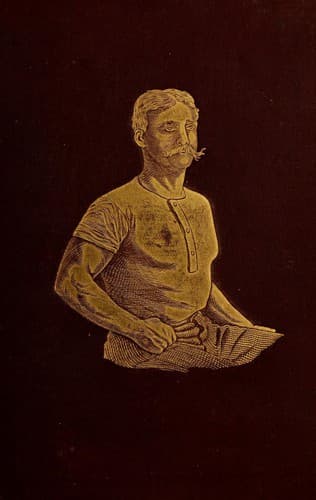
How to Get Strong and How to Stay SoBlaikie, William
Science
How to Get Strong and How to Stay So
Blaikie, William
Physical education and training
Rowing, either at the oar or the rowing-weights, would have told equally
hard on these muscles, and, as already pointed out, on many others
besides, the weight of the body itself aiding the development as it
would not with the bells or weights. It would also broaden the shoulders
and spread them apart, more, perhaps, than almost any other known
exercise. But, like any other single exercise calling certain muscles
into play and leaving others idle, taken as substantially one's only
exercise, as is too often the case with rowing-men, it brings a partial
and one-sided development, making the parts used look too large for the
rest, the fact being that the rest have not been brought up as fast as
the former. Unless one's chest is unusually broad and strong, and often,
even if it is, constant rowing warps his shoulders forward, and tends
directly to make him a round-shouldered man,[M] while the upper arm, or
that part above the elbow, has had practically no development, the inner
part of the triceps or back-arm alone being called to severe duty, but
the bulk being almost idle. Courtney, the greatest sculler the United
States has yet produced--a large man, standing six feet and half an inch
in height, strongly made in most parts, and weighing ordinarily nearly a
hundred and ninety--is a good instance of how rowing does little for the
upper arm; for while his forearm is almost massive, measuring exactly
thirteen inches in girth, the upper arm, doubled up, barely reaches
fourteen. A well-proportioned arm, of which the forearm girths thirteen,
should measure above all fifteen and a quarter. Again, while Courtney's
forearm feels sinewy and hard, the upper is not nearly so hard, and
does not give the impression of having seen very stiff service.
His chest, too, is not so large by over two inches as ought to go
with a thirteen-inch forearm.
Beside these exercises with the dumb-bells, the weights, and the oar,
all the vocations which cause one to stoop over much and lift--such as
most of those of the farmer, the laborer, and of the artisan in the
heavier kinds of work--tell on these same muscles of the upper back and
the inner side of the triceps, too often bringing, as already pointed
out, a far better back than front, and so injuring the form and
carriage. Lifting heavy weights where one stands nearly erect, as when
practising on the lifting-machine, pulls very heavily on the extreme
upper muscles of the back, those sloping off downward from the back of
the neck to the shoulders.
_To obtain a good Biceps._
Public-domain text, read in full here on John Shaqi.
Reviews
Reviews
No reviews yet
Be the first to share your thoughts on this work.
Elsewhere in the archive
Join the Discussion
Join the discussion
Sign in to leave a comment or review.
Sign InorCreate an account