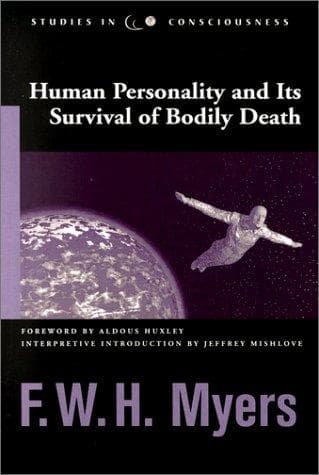
Human Personality and Its Survival of Bodily DeathMyers, F. W. H. (Frederic William Henry)
Religion
Human Personality and Its Survival of Bodily Death
Myers, F. W. H. (Frederic William Henry)
Immortality; Parapsychology; Personality
Let us then consider the specific characteristics of sleep. The
definition of sleep is an acknowledged _crux_ in physiology. And I would
point out that the increased experience of hypnotic sleep which recent
years have afforded has made this difficulty even more striking than
before. A physiological explanation must needs assume that some special
bodily condition,--such, for instance, as the clogging of the brain by
waste-products,--is at least the usual antecedent of sound sleep. But it
is certain, on the other hand, that with a large percentage of persons
profound and prolonged sleep can be induced, in _any_ bodily condition,
by simple suggestion. Hypnosis, indeed (as Wetterstrand and others have
shown) may be prolonged, with actual benefit to the sleeper, far beyond
the point which the spontaneous sleep of a healthy subject ever reaches.
A good subject can be awakened and thrown into hypnosis again almost at
pleasure, and independently of any state either of nutrition or of
fatigue. Such sleep belongs to those phenomena which we may call nervous
if we will, but which we can observe or influence from the psychological
side alone.
We can hardly hope, from the ordinary data, to arrive at a definition of
sleep more satisfactory than others have reached. We must defer that
attempt until we have collected something more than the ordinary
evidence as to what occurs or does not occur during the abeyance of
waking life. One point, however, is plain at once. We cannot treat
sleep,--as it has generally been treated,--in its purely _negative_
aspect. We cannot be content merely to dwell, with the common
text-books, on the mere _absence_ of waking faculties;--on the
diminution of external perception, the absence of controlling
intelligence. We must treat sleep _positively_, so far as we can, as a
definite phase of our personality, co-ordinate with the waking phase.
Each phase, as I believe, has been differentiated alike from a primitive
indifference;--from a condition of lowly organisms which merited the
name neither of sleep nor of waking. Nay, if there were to be a contest
as to which state should be deemed primary and which secondary, sleep
might put forward its claim to be regarded as the more primitive phase.
It is sleep rather than vigilance which prenatal and infantile life
suggest; and even for us adults, however much we may associate ourselves
in thought with the waking state alone, that state has at least thus
much of secondary and adventitious that it is maintained for short
periods only, which we cannot artificially lengthen, being plainly
unable to sustain itself without frequent recourse to that fuller influx
of vitality which slumber brings.
Public-domain text, read in full here on John Shaqi.
Reviews
Reviews
No reviews yet
Be the first to share your thoughts on this work.
Elsewhere in the archive
Join the Discussion
Join the discussion
Sign in to leave a comment or review.
Sign InorCreate an account