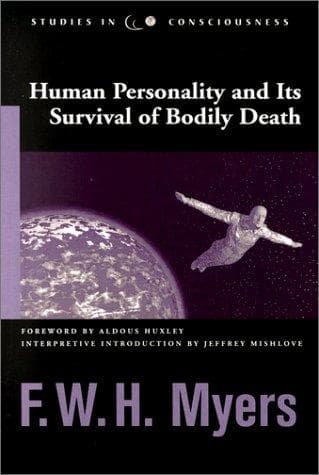
Human Personality and Its Survival of Bodily DeathMyers, F. W. H. (Frederic William Henry)
Religion
Human Personality and Its Survival of Bodily Death
Myers, F. W. H. (Frederic William Henry)
Immortality; Parapsychology; Personality
Take first the degree of control over the voluntary muscles. In ordinary
sleep this is neither possessed nor desired; in nightmare its loss is
exaggerated, in quasi-hysterical fashion, into an appalling fear; while
in somnambulism,--a kind of new personality developed _ad hoc_,--the
sleeper (as we shall see later on) walks on perilous ridges with steady
feet. I have already said that morbid somnambulism bears to sound sleep
a relation something like that which hysteria bears to normal life. But
between the healthy somnambulist and the subject of nightmare we find
from another point of view a contrast resembling that between the man
of genius and the hysteric. The somnambulist, like the man of genius,
brings into play resources which are beyond ordinary reach. On the other
hand, just as in many hysterics certain ordinary powers of movement have
lapsed below voluntary control, so also the dreamer who dimly wishes to
move a constrained limb is often unable to send thither a sufficient
current of motor energy to effect the desired change of position. That
nightmare inability to move, which we thus feel in dream,--"when neither
he that fleeth can flee, nor he that pursueth pursue,"--that sensation
which both Homer and Virgil have selected as the type of paralysing
bewilderment,[39]--this is just the _aboulia_ of the hysteric;--the
condition when it takes a man half an hour to put on his hat, or when a
woman sits all the morning looking at her knitting, but unable to add a
stitch.
"Somnambulism," however, is too vague and undefined a term for our
present discussion. It will only be by a comparison with hypnotism, in
the next chapter, that we can hope to get some clearer notion of
"sleep-waking" states.
Let us pass on to consider _entencephalic sensory faculty_,--"mind's
eye" faculty,--as shown in sleep or dream. Here too we shall find the
same rule to prevail as with motor faculty. That is to say, on the whole
the sensory faculty is of course dimmed and inhibited by sleep; but
there are nevertheless indications of a power subsisting as vividly as
ever, or with even added acuteness.
Baillarger in France and Griesinger in Germany (both about 1845) were
among the first to call attention to the vivid images which rise before
the internal vision of many persons, between sleep and waking. M. Alfred
Maury, the well-known Greek scholar and antiquary, gave to these images
a few years later the title of _illusions hypnagogiques_, and published
a remarkable series of observations upon himself. Mr. Galton has further
treated of them in his _Inquiry into Human Faculty_; and cases will be
found in _Phantasms of the Living_, vol. i, pp. 390, 473, etc.
Public-domain text, read in full here on John Shaqi.
Reviews
Reviews
No reviews yet
Be the first to share your thoughts on this work.
Elsewhere in the archive
Join the Discussion
Join the discussion
Sign in to leave a comment or review.
Sign InorCreate an account