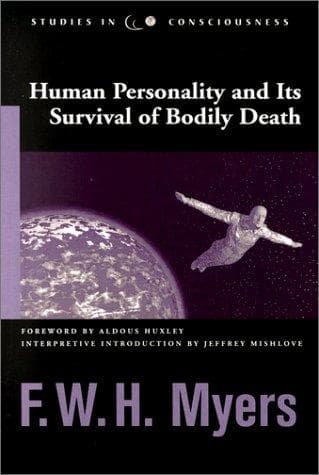
Human Personality and Its Survival of Bodily DeathMyers, F. W. H. (Frederic William Henry)
Religion
Human Personality and Its Survival of Bodily Death
Myers, F. W. H. (Frederic William Henry)
Immortality; Parapsychology; Personality
With regard to memory, as with regard to sensation, we seem in waking
life to be dealing with a selection made for purposes of earthly use.
From the pre-conscious unselective memory which depends on the mere
organisation of living matter, it is the task of consciousness, as it
dawns in each higher organism, to make its own appropriate selection and
to develop into distinctness certain helpful lines of reminiscence. The
question of self-preservation--What must I needs be aware of in order to
escape my foes?--involves the question, What must I needs remember in
order to act upon the facts of which I am aware? The selected currents
of memory follow the selected avenues of sensation; what by disuse I
lose the power of noticing at the time, I also lose the power of
recalling afterwards.
For simpler organisms this rule may perhaps suffice. Man needs a more
complex formula. For it may happen, as we have already seen, that two or
more phases of personality in one man may each select from the mass of
potential reminiscences a special group of memories of its own. These
special groups, moreover, may bear to one another all kinds of
relations; one may include another, or they may alternate and may be
apparently co-exclusive.
From these dissociations and alternations of memory there will be many
lessons to learn. The lesson which here presents itself is not the least
important. What is the relation of the sleeping state to these
dissociated, these parallel or concentric memories? Is it the case that
when one memory includes another it is the waking memory--as one might
expect from that state's apparently superior vividness--which shows
itself the deeper, the more comprehensive record?
Public-domain text, read in full here on John Shaqi.
Reviews
Reviews
No reviews yet
Be the first to share your thoughts on this work.
Elsewhere in the archive
Join the Discussion
Join the discussion
Sign in to leave a comment or review.
Sign InorCreate an account