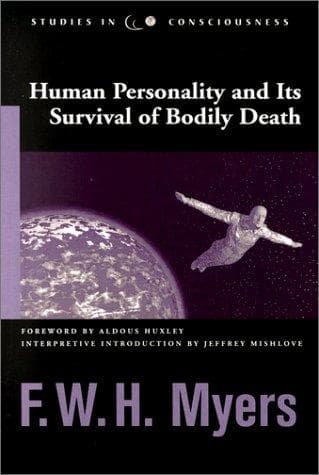
Human Personality and Its Survival of Bodily DeathMyers, F. W. H. (Frederic William Henry)
Religion
Human Personality and Its Survival of Bodily Death
Myers, F. W. H. (Frederic William Henry)
Immortality; Parapsychology; Personality
Conversely, dreams forgotten in waking life may be remembered in the
hypnotic trance. Thus Dr. Tissié's patient, Albert, dreamt that he was
about to set out on one of his somnambulic "fugues," or aimless
journeys, and when hypnotised mentioned to the physician this dream,
which in his waking state he had forgotten.[45] The probable truth of
this statement was shown by the fact that he did actually set out on the
journey thus dreamt of, and that his journeys were usually preceded and
incited by remembered dreams.
I need not dwell on the existence, but at the same time the
incompleteness, of our dream-memory of waking life; nor on the
occasional formation of a separate chain of memory, constructed from
successive and cohering dreams. It should be added that we do not really
know how far our memory in dream of waking life may have extended; since
we can only _infer_ this from our notoriously imperfect waking memory of
past dreams.
A cognate anticipation to which our theory will point will be that
dream-memory will occasionally be found to fill up gaps in waking
memory, other than those due to hypnotic trance; such so-called
"ecmnesic" periods, for instance, as sometimes succeed a violent shock
to the system, and may even embrace some space of time _anterior_ to the
shock. These periods themselves resemble prolonged and unremembered
dreams. Such accidents, however, are so rare, and such dream-memory so
hard to detect, that I mention the point mainly for the sake of
theoretical completeness; and must think myself fortunate in being able
to refer the reader to a recent case of M. Charcot's which affords an
interesting confirmation of the suggested view.[46]
I pass on to the still more novel and curious questions involved in the
apparent existence of a dream-memory which, while accompanying the
memory of ordinary life, seems also to have a wider purview, and to
indicate that the record of external events which is kept within us is
far fuller than we know.
Let us consider what stages such a memory may show.
I. It may include events once known to the waking self, but now
definitely forgotten.
Public-domain text, read in full here on John Shaqi.
Reviews
Reviews
No reviews yet
Be the first to share your thoughts on this work.
Elsewhere in the archive
Join the Discussion
Join the discussion
Sign in to leave a comment or review.
Sign InorCreate an account