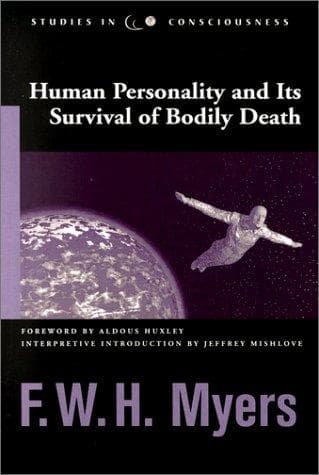
Human Personality and Its Survival of Bodily DeathMyers, F. W. H. (Frederic William Henry)
Religion
Human Personality and Its Survival of Bodily Death
Myers, F. W. H. (Frederic William Henry)
Immortality; Parapsychology; Personality
May I not, then, claim a real analogy between certain of the
achievements of _sleep_ and the achievements of _genius_? In both there
is the same triumphant spontaneity, the same sense of drawing no longer
upon the narrow and brief endurance of nerves and brain, but upon some
unknown source exempt from those limitations.
Thus far, indeed, the sleep-faculties which we have been considering,
however strangely intensified, have belonged to the same class as the
normal faculties of waking life. We have now to consider whether we can
detect in sleep any manifestation of _supernormal_ faculty--any
experience which seems to suggest that man is a cosmical spirit as well
as a terrestrial organism, and is in some way in relation with a
spiritual as well as with a material world. It will seem, in this view,
to be natural that this commerce with a spiritual environment should be
more perceptible in sleep than in waking. The dogma which my point of
view thus renders probable is perhaps, as a mere matter of history, the
dogma of all dogmas which has been most universally believed by mankind.
"_Quod semper, quod ubique, quod ab omnibus_"--for how many narrow
theological propositions have we not heard this proud claim--that they
have been believed everywhere, and by everybody, and in every age? Yet
what can approach the antiquity, the ubiquity, the unanimity of man's
belief in the wanderings of the spirit in dream? In the Stone Age, the
sceptic would have been rash indeed who ventured to contradict it. And
though I grant that this "palæolithic psychology" has gone out of
fashion for the last few centuries, I do not think that (in view of the
telæsthetic evidence now collected) we can any longer dismiss as a mere
_bizarrerie_ of dream-imagery the constant recurrence of the idea of
visiting in sleep some distant scene,--with the acquisition thereby of
new facts not otherwise accessible.
Public-domain text, read in full here on John Shaqi.
Reviews
Reviews
No reviews yet
Be the first to share your thoughts on this work.
Elsewhere in the archive
Join the Discussion
Join the discussion
Sign in to leave a comment or review.
Sign InorCreate an account