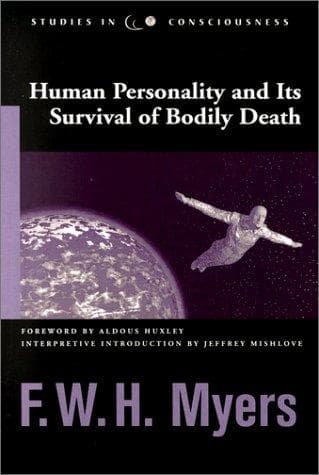
Human Personality and Its Survival of Bodily DeathMyers, F. W. H. (Frederic William Henry)
Religion
Human Personality and Its Survival of Bodily Death
Myers, F. W. H. (Frederic William Henry)
Immortality; Parapsychology; Personality
I begin, then, with some dreams which seem to carry perceptive faculty
beyond the point at which some unusual form of common vision can be
plausibly suggested in explanation. Mr. Lewis's dream of the
landing-order (Appendix IV. A) may be taken as an instance of such a
dream.[50]
I will next refer to certain cases where the sleeper by clairvoyant
vision discerns a scene of direct interest to a mind other than his
own;--as the danger or death of some near friend. Sometimes there is a
flash of vision, which seems to represent correctly the critical scene.
Sometimes there is what seems like a longer gaze, accompanied, perhaps
by some sense of _communion_ with the invaded person. And in some few
cases--the most interesting of all--the circumstances of a death seem to
be symbolically _shown_ to a dreamer, as though by the deceased person,
or by some intelligence connected with him. (See Mrs. Storie's narrative
p. 109.)
One of the best instances of the flash of vision is Canon Warburton's,
which I quote from _Phantasms of the Living_, vol. i. p. 338--a case
whose remoteness is rendered less of a drawback than usual by the
character of the narrator and the simplicity and definiteness of the
fact attested.
The following is his account:--
THE CLOSE, WINCHESTER, _July 16th, 1883_.
Somewhere about the year 1848 I went up from Oxford to stay a day
or two with my brother, Acton Warburton, then a barrister, living
at 10 Fish Street, Lincoln's Inn. When I got to his chambers I
found a note on the table apologising for his absence, and saying
that he had gone to a dance somewhere in the West End, and intended
to be home soon after one o'clock. Instead of going to bed, I dozed
in an arm-chair, but started up wide awake exactly at one,
ejaculating "By Jove! he's down!" and seeing him coming out of a
drawing-room into a brightly illuminated landing, catching his foot
in the edge of the top stair, and falling headlong, just saving
himself by his elbows and hands. (The house was one which I had
never seen, nor did I know where it was.) Thinking very little of
the matter, I fell a-doze again for half an hour, and was awakened
by my brother suddenly coming in and saying, "Oh, there you are! I
have just had as narrow an escape of breaking my neck as I ever had
in my life. Coming out of the ballroom, I caught my foot, and
tumbled full length down the stairs."
That is all. It may have been "only a dream," but I always thought
it must have been something more.
W. WARBURTON.
In a second letter Canon Warburton adds:--
_July 20th, 1883._
Public-domain text, read in full here on John Shaqi.
Reviews
Reviews
No reviews yet
Be the first to share your thoughts on this work.
Elsewhere in the archive
Join the Discussion
Join the discussion
Sign in to leave a comment or review.
Sign InorCreate an account