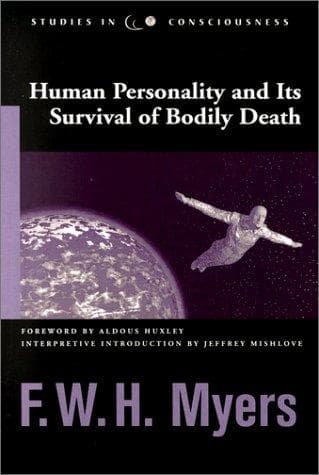
Human Personality and Its Survival of Bodily DeathMyers, F. W. H. (Frederic William Henry)
Religion
Human Personality and Its Survival of Bodily Death
Myers, F. W. H. (Frederic William Henry)
Immortality; Parapsychology; Personality
We shall thus have two phases of personality developing into separate
purposes and in separate directions from a parent stem. The waking
personality will develop external sense organs and will fit itself
progressively for the life of relation to the external world. It will
endeavour to attain an ever completer control over the resources of the
personality, and it will culminate in what we term _genius_ when it has
unified the subliminal as far as possible with the supraliminal in its
pursuit of deliberate waking ends.
The sleeping personality will develop in ways less easy to foresee.
What, on any theory, will it aim at, beyond the familiar intensification
of recuperative power? We can only guess, on my theory, that its
development will show some increasing trace of the soul's less exclusive
absorption in the activity of the organism. The soul has withdrawn from
the specialised material surface of things (to use such poor metaphor as
we can) into a realm where the nature of the connection between matter
and spirit--whether through the intermediacy of the ether or
otherwise--is more profoundly discerned. That same withdrawal from the
surface which, while it diminishes power over complex muscular
processes, increases power over profound organic processes, may at the
same time increase the soul's power of operating in that spiritual world
to which sleep has drawn it nearer.
On this view of sleep, be it observed, there will be nothing to surprise
us in the possibility of increasing the proportion of the sleeping to
the waking phase of life by hypnotic suggestion. All we can say is that,
while the soul must insist on at least the minimum quantity of sleep
needful to keep the body alive, we can see no superior limit to the
quantity of sleep which it may choose to take,--the quantity of
attention, that is, which it may choose to give to the special
operations of sleep as compared with those of waking life.
At this point we must for the present pause. The suggested hypothesis
will indeed cover the actual facts as to sleep adduced in this chapter.
But it covers them by virtue of assumptions too vast to be accepted
without further confirmation. It must necessarily be our duty in later
chapters to trace the development of the sleeping personality in both
the directions indicated above;--in the direction of organic
recuperation through the hypnotic trance, and in the direction of the
soul's independent operation through that form of trance which leads to
possession and to ecstasy. We shall begin at once in the next chapter to
trace out that great experimental modification of sleep, from which,
under the names of mesmerism or of hypnotism, results of such
conspicuous practical value have already been won.
CHAPTER V
HYPNOTISM
εἱλετο ἑ ῥἁβδον, τὑ τ' ἁνδρὡν δμματα θελγει,
ὁν ἑθἑλει, τοὑς δ' αὑτε κἱ ὑπνὡοτας ἑγεἱρι.
--HOMER.
Public-domain text, read in full here on John Shaqi.
Reviews
Reviews
No reviews yet
Be the first to share your thoughts on this work.
Elsewhere in the archive
Join the Discussion
Join the discussion
Sign in to leave a comment or review.
Sign InorCreate an account