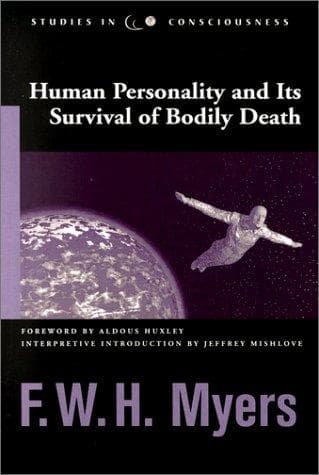
Human Personality and Its Survival of Bodily DeathMyers, F. W. H. (Frederic William Henry)
Religion
Human Personality and Its Survival of Bodily Death
Myers, F. W. H. (Frederic William Henry)
Immortality; Parapsychology; Personality
Gurney held the view that the main distinction of kind between his
"alert" and his "deep" stage of hypnosis was to be found in the domain
of memory, while memory also afforded the means for distinguishing the
hypnotic state as a whole from the normal one. As a general rule (though
with numerous exceptions), the events of ordinary life are remembered
in the trance, while the trance events are forgotten on waking, but tend
to recur to the memory on rehypnotisation. But the most interesting part
of his observations consisted in showing alternations of memory in the
alert and deep stages of the trance itself;--the ideas impressed in the
one sort of state being almost always forgotten in the other, and as
invariably again remembered when the former state recurs. (_Proceedings_
S.P.R. vol. ii., pp. 61 _et seq._ [523 A].) On experimenting further, he
met with a stage in which there was a distinct third train of memory,
independent of the others;--and this, of course, suggests a further
doubt as to there being any fixed number of stages in the trance. The
later experiments of Mrs. Sidgwick [523 B] on the same subject, in which
eight or nine distinct trains of memory were found--each recurring when
the corresponding stage of depth of the trance was reached--seem to show
conclusively that the number, may vary almost indefinitely. We have
already seen that in cases of alternating personalities the number of
personalities similarly varies, and the student who now follows or
repeats Gurney's experiments, with the increased knowledge of split
personalities which recent years have brought, cannot fail to be struck
with the analogies between Gurney's artificial light and deep
states,--with their separate chains of memory,--and those morbid
alternating personalities, with their complex mnemonic cleavages and
lacunæ, with which we dealt in Chapter II. The hypnotic stages are in
fact secondary or alternating personalities of very shallow type, but
for that very reason all the better adapted for teaching us from what
kinds of subliminal disaggregation the more serious splits in
personality take their rise.
And beneath and between these awakenings into limited, partial alertness
lies that profound hypnotic trance which one can best describe as a
scientific or purposive rearrangement of the elements of sleep;--a
rearrangement in which what is helpful is intensified, what is merely
hindering or isolating is removed or reduced. A man's ordinary sleep is
at once unstable and irresponsive. You can wake him with a pin-prick,
but if you talk to him he will not hear or answer you, until you rouse
him with the mere noise. That is sleep as the needs of our timorous
ancestors determined that it should be.
Hypnotic sleep, on the contrary, is at once stable and responsive;
strong in its resistance to such stimuli as it chooses to ignore; ready
in its accessibility to such appeals as it chooses to answer.
Public-domain text, read in full here on John Shaqi.
Reviews
Reviews
No reviews yet
Be the first to share your thoughts on this work.
Elsewhere in the archive
Join the Discussion
Join the discussion
Sign in to leave a comment or review.
Sign InorCreate an account