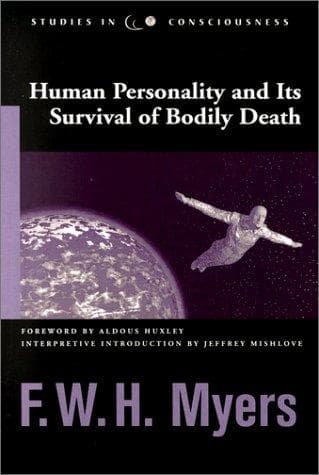
Human Personality and Its Survival of Bodily DeathMyers, F. W. H. (Frederic William Henry)
Religion
Human Personality and Its Survival of Bodily Death
Myers, F. W. H. (Frederic William Henry)
Immortality; Parapsychology; Personality
Before leaving this subject of spontaneous sleep-waking states I ought
briefly to mention a form of trance with which we shall have to deal
more at length in a later chapter. I speak of trance ascribed to
_spirit-possession_. As will be seen, I myself fully adopt this
explanation in a small number of the cases where it is put forward. Yet
I do not think that spirit-agency is necessarily present in all the
trances even of a true subject of possession. With all the leading
sensitives--with D. D. Home, with Stainton Moses, with Mrs. Piper and
with others--I think that the depth of the trance has varied greatly on
different occasions, and that sometimes the subliminal self of the
sensitive is vaguely simulating, probably in an unconscious dream-like
way, an external intelligence. This hypothesis suggested itself to
several observers in the case especially of D. D. Home, with whom the
moments of strong characterisation of a departed personality, though far
from rare, were yet scattered among tracts of dreamy improvisation which
suggested only the utterance of Home's subliminal self. However we
choose to interpret these trances, they should be mentioned in
comparison with all the other sleep-waking states. They probably form
the best transition between those shallow somnambulisms, on the one
hand, which are little more than a vivid dream, and those profound
trances, on the other hand, in which the native spirit quits, as nearly
as may be, the sensitive's organism, and is for the time replaced, as
nearly as may be, by an invading spirit from that unseen world.
This brief review of non-hypnotic somnambulisms has not been without its
lessons. It has shown us that the supernormal powers which we have
traced in each of the preceding chapters in turn do also show
themselves, in much the same fashion, in spontaneous sleep-waking states
of various types. We must now inquire how far they occur in sleep-waking
states experimentally induced.
And here the very fact of _induction_ suggests to us a question
specially applicable to the hypnotic state itself. Is hypnosis ever
supernormally induced? Can any one, that is to say, be thrown into
hypnotic trance by a telepathic impact? or, to phrase it more generally,
by any influence, inexplicable by existing science, which may pass from
man to man?
Public-domain text, read in full here on John Shaqi.
Reviews
Reviews
No reviews yet
Be the first to share your thoughts on this work.
Elsewhere in the archive
Join the Discussion
Join the discussion
Sign in to leave a comment or review.
Sign InorCreate an account