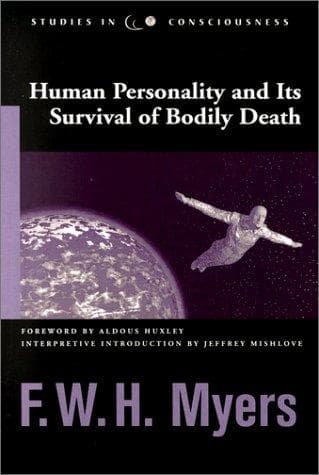
Human Personality and Its Survival of Bodily DeathMyers, F. W. H. (Frederic William Henry)
Religion
Human Personality and Its Survival of Bodily Death
Myers, F. W. H. (Frederic William Henry)
Immortality; Parapsychology; Personality
It is, however, in my view, by no means improbable that effluences, as
yet unknown to science, but perceptible by sensitive persons as the
telepathic impulse is perceptible, should radiate from living human
organisms. I see no reason to assume that the varied and concordant
statements made by patients in the _Zoist_ and early mesmeric works
merely reflect subjective fancies. I have myself performed and witnessed
experiments on intelligent persons expressly designed to test whether or
no the sensation following the hand was a mere fancy. It seems to me
hardly likely that persons who have never experienced other purely
subjective sensations, and who are expressly alive to the question here
at issue, should nevertheless again and again feel the classical
tingling, etc., along the track of the hypnotiser's passes without any
real external cause. To assume that all which they feel is a mere result
of suggestion, may be a premature attempt at simplifying modes of
supernormal communication which, in fact, are probably not simpler but
more complex than any idea which we have as yet formed of them.
And here at last we arrive at what is in reality the most interesting
group of inquiries connected with the hypnotic trance.
We have just seen that the subliminal state of the hypnotised subject
may be approached by ways subtler than mere verbal suggestion--by
telepathic impacts and perhaps by some effluence of kindred supernormal
type. We have now to trace the supernormal elements in the hypnotic
_response_. Whether those elements are most readily excited by a
directly subliminal appeal, or whether they depend mainly on the special
powers innate in the hypnotised person, we can as yet but imperfectly
guess. We can be pretty sure, at any rate, that they are not often
evoked in answer to any rapid and, so to say, perfunctory hypnotic
suggestion; they do not spring up in miscellaneous hospital practice;
they need an education and a development which is hardly bestowed on
one hypnotised subject in a hundred. The first stage of this response
lies in a subliminal relation established between the subject and his
hypnotiser, and manifesting itself in what is called _rapport_, or in
_community of sensation_. The earlier stages of _rapport_--conditions
when the subject apparently bears or feels the hypnotiser only, and so
forth--arise probably from mere self-suggestion or from the suggestions
of the operator, causing the conscious attention of the subject to be
exclusively directed to him. Indications of the possible development of
a real link between the two persons may rather be found in the cases
where there is provable community of sensation,--the hypnotised subject
tasting or feeling what the hypnotiser (unknown to the subject) does
actually at that moment taste or feel.
Public-domain text, read in full here on John Shaqi.
Reviews
Reviews
No reviews yet
Be the first to share your thoughts on this work.
Elsewhere in the archive
Join the Discussion
Join the discussion
Sign in to leave a comment or review.
Sign InorCreate an account