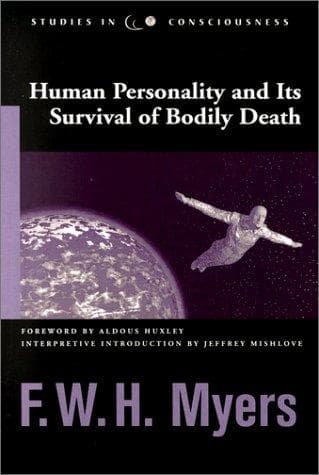
Human Personality and Its Survival of Bodily DeathMyers, F. W. H. (Frederic William Henry)
Religion
Human Personality and Its Survival of Bodily Death
Myers, F. W. H. (Frederic William Henry)
Immortality; Parapsychology; Personality
Another most important corollary of this excursive theory must just be
mentioned here. If there be spiritual excursion to a particular point of
space, it is conceivable that this should involve not only the migrant
spirit's perception _from_ that point, but also perception of that point
by persons materially present near it. That point may become a
_phantasmogenetic centre_, as well as a centre of outlook. In plain
words, if A has spiritually invaded B's room, and there sees B, B on his
part may see A symbolically standing there; and C and D if present may
see A as well.
This hint, here thrown out as an additional argument for the excursive
theory, will fall to be developed later on. For the present we must
confine our attention to our immediate subject: the range of man's inner
vision, and the means which he must take to understand, to foster, and
to control it.
The first and simplest step in the control of inner vision is the
repression by hypnotic suggestion of degenerative hallucinations. It is
a noteworthy fact that such of these as are at all curable are much more
often curable by hypnotism than in any other way.
The next step is one to which, as the reader of my chapter on hypnotism
already knows, I attribute an importance much greater than is generally
accorded to it. I refer to the hypnotiser's power not only of
controlling but of _inducing_ hallucinations in his subject.
As I have already said, the evocation of hallucinations is commonly
spoken of as a mere example of the subject's _obedience_ to the
hypnotiser. "I tell my subject to raise his arm, and he raises it; I
tell him to see a tiger in the room, and he sees one accordingly." But
manifestly these two incidents are not on the same level, and only
appear to be so through a certain laxity of language. The usage of
speech allows me to say, "I will make my subject lift his arm," although
I am of course unable to affect the motor centres in his brain which
start that motion. But it is so easy for a man to lift his arm that my
speech takes that familiar power for granted, and notes, only his
readiness to lift it when I tell him--the hypnotic complaisance which
prompts him to obey me if I suggest this trivial action. But when I say,
"I will make him see a tiger," I take for granted a power on his part
which is _not_ familiar, which I have no longer a right to assume. For
under ordinary circumstances my subject simply _cannot_ see a tiger at
will; nor can I affect the visual centres which might enable him to do
so. All that I can ask him to do, therefore, is to choose this
particular way of indicating that in his hypnotic condition he has
become able to stimulate his central sensory tracts more powerfully than
ever before.
Public-domain text, read in full here on John Shaqi.
Reviews
Reviews
No reviews yet
Be the first to share your thoughts on this work.
Elsewhere in the archive
Join the Discussion
Join the discussion
Sign in to leave a comment or review.
Sign InorCreate an account