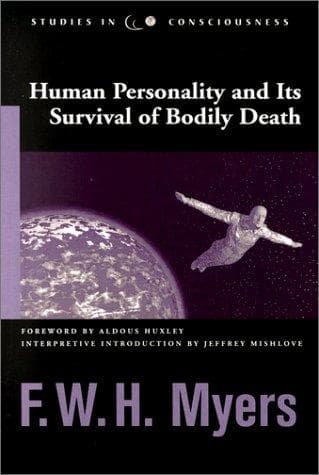
Human Personality and Its Survival of Bodily DeathMyers, F. W. H. (Frederic William Henry)
Religion
Human Personality and Its Survival of Bodily Death
Myers, F. W. H. (Frederic William Henry)
Immortality; Parapsychology; Personality
Thus much, one may say, has been evident since man first speculated on
such subjects at all. But the advance of knowledge has added a new
presumption--it can be no more than a presumption--to all such cosmic
speculations. I mean the presumption of _continuity_. Learning how close
a tie in reality unites man with inferior lives,--once treated as
something wholly alien, impassably separated from the human race--we are
led to conceive that a close tie may unite him also with superior
lives,--that the series may be fundamentally unbroken, the essential
qualities of life the same throughout. It used to be asked whether man
was akin to the ape or to the angel. I reply that the very fact of his
kinship with the ape is proof presumptive of his kinship with the angel.
It is natural enough that man's instinctive feeling should have
anticipated any argument of this speculative type. Men have in most ages
believed, and do still widely believe, in the reality of prayer; that
is, in the possibility of telepathic communication between our human
minds and minds above our own, which are supposed not only to understand
our wish or aspiration, but to impress or influence us inwardly in
return.
So widely spread has been this belief in prayer that it is somewhat
strange that men should not have more commonly made what seems the
natural deduction--namely, that if our spirits can communicate with
higher spirits in a way transcending sense, they may also perhaps be
able in like manner to communicate with each other. The idea, indeed,
has been thrown out at intervals by leading thinkers--from Augustine to
Bacon, from Bacon to Goethe, from Goethe to Tennyson.
Isolated experiments from time to time indicated its practical truth.
Yet it is only within the last few years that the vague and floating
notion has been developed into definite theory by systematic experiment.
To make such experiment possible has indeed been no easy matter. It has
been needful to elicit and to isolate from the complex emotions and
interactions of common life a certain psychical element of whose nature
and working we have beforehand but a very obscure idea.
If indeed we possessed any certain method of detecting the action of
telepathy,--of distinguishing it from chance coincidence or from
unconscious suggestion,--we should probably find that its action was
widely diffused and mingled with other more commonplace causes in many
incidents of life. We should find telepathy, perhaps, at the base of
many sympathies and antipathies, of many wide communities of feeling;
operating, it may be, in cases as different as the quasi-recognition of
some friend in a stranger seen at a distance just before the friend
himself unexpectedly appears, and the _Phêmê_ or Rumour which in
Hindostan or in ancient Greece is said to have often spread far an
inexplicable knowledge of victory or disaster.
Public-domain text, read in full here on John Shaqi.
Reviews
Reviews
No reviews yet
Be the first to share your thoughts on this work.
Elsewhere in the archive
Join the Discussion
Join the discussion
Sign in to leave a comment or review.
Sign InorCreate an account