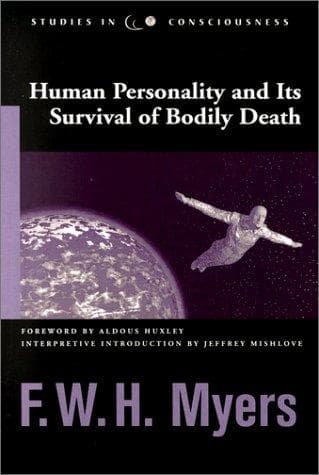
Human Personality and Its Survival of Bodily DeathMyers, F. W. H. (Frederic William Henry)
Religion
Human Personality and Its Survival of Bodily Death
Myers, F. W. H. (Frederic William Henry)
Immortality; Parapsychology; Personality
The hypothesis is an attractive one; because
it fits an agency which certainly exists, but whose effect is unknown,
to an effect which certainly exists, but whose agency is unknown.
In this world of vibrations it may seem at first the simplest plan to
invoke a vibration the more. It would be rash, indeed, to affirm that
any phenomenon perceptible by men may not be expressible, in part at
least, in terms of ethereal undulations. But in the case of telepathy
the analogy which suggests this explanation, the obvious likeness
between the picture emitted (so to say) by the agent and the picture
received by the percipient--as when I fix my mind on the two of
diamonds, and he sees a mental picture of that card--goes but a very
short way. One has very soon to begin assuming that the percipient's
mind _modifies_ the picture despatched from the agent: until the
likeness between the two pictures becomes a quite symbolical affair. We
have seen that there is a continuous transition from experimental to
spontaneous telepathy; from our transferred pictures of cards to
monitions of a friend's death at a distance. These monitions may indeed
be pictures of the dying friend, but they are seldom such pictures as
the decedent's brain seems likely to project in the form in which they
reach the percipient. Mr. L.--to take a well-known case in our
collection (_Phantasms of the Living_, vol. i. p. 210)--dies of heart
disease when in the act of lying down undressed, in bed. At or about
the same moment Mr. N. J. S. sees Mr. L. standing beside him with a
cheerful air, dressed for walking and with a cane in his hand. One does
not see how a system of undulations could have transmuted the physical
facts in this way.
A still greater difficulty for the vibration-theory is presented by
_collective_ telepathic hallucinations. It is hard to understand how A
can emit a pattern of vibrations which, radiating equally in all
directions, shall affect not only his distant friend B, but also the
strangers C and D, who happen to be standing near B;--and affect no
other persons, so far as we know, in the world.
Public-domain text, read in full here on John Shaqi.
Reviews
Reviews
No reviews yet
Be the first to share your thoughts on this work.
Elsewhere in the archive
Join the Discussion
Join the discussion
Sign in to leave a comment or review.
Sign InorCreate an account