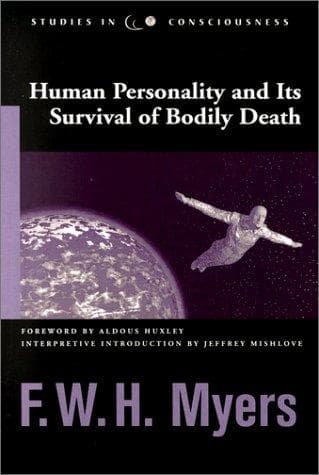
Human Personality and Its Survival of Bodily DeathMyers, F. W. H. (Frederic William Henry)
Religion
Human Personality and Its Survival of Bodily Death
Myers, F. W. H. (Frederic William Henry)
Immortality; Parapsychology; Personality
The hypothesis which I suggested in _Phantasms of the Living_ itself, in
my "Note on a possible mode of psychical interaction," seems to me to
have been rendered increasingly plausible by evidence of many kinds
since received; evidence of which the larger part falls outside the
limits of this present work. I still believe--and more confidently than
in 1886--that a "psychical invasion" does take place; that a
"phantasmogenetic centre" is actually established in the percipient's
surroundings; that some movement bearing some relation to space as we
know it is actually accomplished; and some presence is transferred, and
may or may not be discerned by the invaded person; some perception of
the distant scene in itself is acquired, and may or may not be
remembered by the invader.
But the words which I am here beginning to use carry with them
associations from which the scientific reader may well shrink. Fully
realising the offence which such expressions may give, I see no better
line of excuse than simply to recount the way in which the gradual
accretion of evidence has obliged me, for the mere sake of covering all
the phenomena, to use phrases and assumptions which go far beyond those
which Edmund Gurney and I employed in our first papers on this inquiry
in 1883.
When in 1882 our small group began the collection of evidence bearing
upon "veridical hallucinations"--or apparitions which coincided with
other events in such a way as to suggest a causal connection--we found
scattered among the cases from the first certain types which were with
difficulty reducible under the conception of telepathy pure and
simple--even if such a conception could be distinctly formed. Sometimes
the apparition was seen by more than one percipient at once--a result
which we could hardly have expected if all that had passed were the
transference of an impression from the agent's mind to another mind,
which then bodied forth that impression in externalised shape according
to laws of its own structure. There were instances, too, where the
percipient seemed to be the agent also--in so far that it was he who had
an impression of having somehow visited and noted a distant scene, whose
occupant was not necessarily conscious of any immediate relation with
him. Or sometimes this "telepathic clairvoyance" developed into
"reciprocity," and each of the two persons concerned was conscious of
the other;--the _scene_ of their encounter being the same in the vision
of each, or at least the experience being in some way common to both.
These and cognate difficulties were present to my mind from the first;
and in the above-mentioned "Note on a suggested mode of psychical
interaction," included in vol. ii of _Phantasms of the Living_, I
indicated briefly the extension of the telepathic theory to which they
seemed to me to point.
Public-domain text, read in full here on John Shaqi.
Reviews
Reviews
No reviews yet
Be the first to share your thoughts on this work.
Elsewhere in the archive
Join the Discussion
Join the discussion
Sign in to leave a comment or review.
Sign InorCreate an account