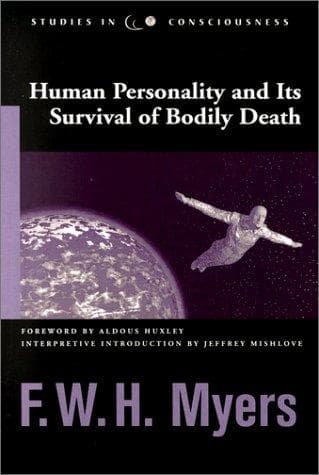
Human Personality and Its Survival of Bodily DeathMyers, F. W. H. (Frederic William Henry)
Religion
Human Personality and Its Survival of Bodily Death
Myers, F. W. H. (Frederic William Henry)
Immortality; Parapsychology; Personality
It must be remembered, in the first place, that all these veridical or
coincidental cases stand out together as a single group from a
background of hallucinations which involve no coincidence, which have no
claim to veridicality. If purely subjective hallucinations of the senses
affected insane or disordered brains alone,--as was pretty generally the
assumption, even in scientific circles, when our inquiry began,--our
task would have been much easier than it is. But while there can be no
question as to the sound and healthy condition of the great majority of
our percipients, Edmund Gurney's "Census of Hallucinations" of 1884,
confirmed and extended by the wider inquiry of 1889-1892, showed a
frequency, previously unsuspected, of scattered hallucinations among
sane and healthy persons, the experience being often unique in a
lifetime, and in no apparent connection with any other circumstance
whatever.[109]
Since casual hallucinations of the sane, then, are thus _frequent_, we
can hardly venture to assume that they are all _veridical_. And the
existence of all these perhaps merely subjective hallucinations greatly
complicates our investigation of veridical hallucinations. It prevents
the mere existence of the hallucinations, however strangely interposed
in ordinary life, from having any evidential value, and throws us upon
evidence afforded by external coincidence;--on the mere fact, to put
such a coincidence in its simplest form, that I see a phantom of my
friend Smith at the moment when Smith is unexpectedly dying at a
distance. A coincidence of this general type, if it occurs, need not be
difficult to substantiate, and we have in fact substantiated it with
more or less completeness in several hundred cases.
The _primâ facie_ conclusion will obviously be that there is a causal
connection between the death and the apparition. To overcome this
presumption it would be necessary either to impugn the accuracy of the
informant's testimony, or to show that chance alone might have brought
about the observed coincidences.
On both of these questions there have been full and repeated discussions
elsewhere. I need not re-argue them at length here, but will refer the
reader to the "Report on the Census of Hallucinations," _Proceedings_
S.P.R., vol. x., where every source of error as yet discovered has been
pretty fully considered.
To that volume also I must refer him for a thorough discussion of the
arguments for and against chance-coincidence. The conclusion to which
the Committee unanimously came is expressed in the closing words:
"Between deaths and apparitions of the dying person a connection exists
which is not due to chance alone."
We have a right, I think, to say that only by another census of
hallucinations, equally careful, more extensive, and yielding absolutely
different results, could this conclusion be overthrown.
Public-domain text, read in full here on John Shaqi.
Reviews
Reviews
No reviews yet
Be the first to share your thoughts on this work.
Elsewhere in the archive
Join the Discussion
Join the discussion
Sign in to leave a comment or review.
Sign InorCreate an account