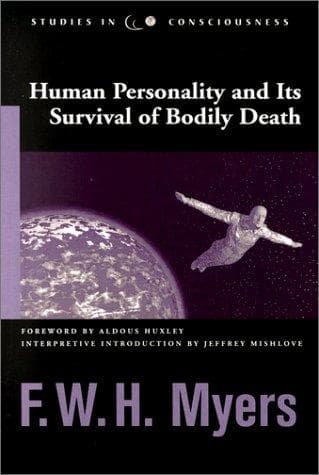
Human Personality and Its Survival of Bodily DeathMyers, F. W. H. (Frederic William Henry)
Religion
Human Personality and Its Survival of Bodily Death
Myers, F. W. H. (Frederic William Henry)
Immortality; Parapsychology; Personality
In a somewhat similar case[113] there is strong attestation that a
sailor, watching by a dying comrade, saw figures around his hammock,
apparently representing the dying man's family, in mourning garb. The
family, although they had no ordinary knowledge of the sailor's illness,
had been alarmed by noises, etc., which rightly or wrongly they took as
indications of some danger to him. I conceive, then, that the wife paid
a psychical visit to her husband; and I take the mourning garb and the
accompanying children's figures to be symbolical accompaniments,
representing her thought, "My children will be orphans." I think this
more likely than that the sailor's children also should have possessed
this rare peculiarity of becoming perceptible at a distant point in
space. And secondary figures, as we shall see later on, are not uncommon
in such telepathic presentations. One may picture oneself as though
holding a child by the hand, or even driving in a carriage and pair, as
vividly as though carrying an umbrella or walking across a room; and one
may be thus pictured to others.
And here I note a gradual transition to the next large class of cases on
which I am about to enter. I am about to deal with _telæsthesia_;--with
cases where an agent-percipient--for he is both in one--makes a
clairvoyant excursion (of a more serious type than the mere
psychorrhagies already described), and brings back some memory of the
scene which he has psychically visited. Now, of course, it may happen
that he fails to bring back any such memory, or that if he _does_ bring
it back, he tells no one about it. In such cases, just as in the
telepathic cases of which I have just spoken, the excursive phantom may
possibly be observed by a bystander, and the circumstances may be such
as to involve some coincidence which negatives the supposition of the
bystander's mere subjective fancy. Such, I think, is the case which I
give in Appendix VI. D.
There is a similar case in _Phantasms of the Living_, vol. ii. p. 541,
where a girl, who is corporeally present in a certain drawing-room, is
seen phantasmally in a neighbouring grove, whither she herself presently
goes and hangs herself.
Ponderings on projected suicide form perhaps the strongest instance of
mental preoccupation with a particular spot. But of course, in our
ignorance of the precise quality of thought or emotion needed to prompt
a psychical excursion, we need not be surprised to find such an
excursion observed on some occasions as trivial as the "arrival-case" of
Col. Reed, with which I prefaced the mere psychorrhagic cases.
Public-domain text, read in full here on John Shaqi.
Reviews
Reviews
No reviews yet
Be the first to share your thoughts on this work.
Elsewhere in the archive
Join the Discussion
Join the discussion
Sign in to leave a comment or review.
Sign InorCreate an account