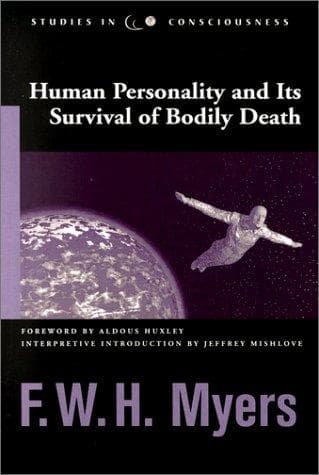
Human Personality and Its Survival of Bodily DeathMyers, F. W. H. (Frederic William Henry)
Religion
Human Personality and Its Survival of Bodily Death
Myers, F. W. H. (Frederic William Henry)
Immortality; Parapsychology; Personality
Let us attempt, then, a truer definition. Instead of describing a
"ghost" as a dead person permitted to communicate with the living, let
us define it as _a manifestation of persistent personal energy_, or as
an indication that some kind of force is being exercised after death
which is in some way connected with a person previously known on earth.
In this definition we have eliminated, as will be seen, a great mass of
popular assumptions. Yet we must introduce a further proviso, lest our
definition still seem to imply an assumption which we have no right to
make. It is theoretically possible that this force or influence, which
after a man's death creates a phantasmal impression of him, may indicate
no continuing action on his part, but may be some residue of the force
or energy which he generated while yet alive. There may be _veridical
after-images_--such as Gurney hints at (_Proceedings_ S.P.R., vol. v. p.
417) when in his comments on the recurring figure of an old woman--seen
on the bed where she was murdered--he remarks that this figure suggests
not so much "any continuing local interest on the part of the deceased
person, as the survival of a mere image, impressed, we cannot guess how,
on we cannot guess what, by that person's physical organism, and
perceptible at times to those endowed with some cognate form of
sensitiveness."
Strange as this notion may seem, it is strongly suggested by many of the
cases of _haunting_ which do not fall within the scope of the present
chapter. We shall presently find that there is strong evidence for the
recurrence of the same hallucinatory figures in the same localities, but
weak evidence to indicate any purpose in most of these figures, or any
connection with bygone individuals, or with such tragedies as are
popularly supposed to start a ghost on its career. In some of these
cases of frequent, meaningless recurrence of a figure in a given spot,
we are driven to wonder whether it can be some deceased person's past
frequentation of that spot, rather than any fresh action of his after
death, which has generated what I have termed the veridical
after-image--veridical in the sense that it communicates information,
previously unknown to the percipient, as to a former inhabitant of the
haunted locality.
Public-domain text, read in full here on John Shaqi.
Reviews
Reviews
No reviews yet
Be the first to share your thoughts on this work.
Elsewhere in the archive
Join the Discussion
Join the discussion
Sign in to leave a comment or review.
Sign InorCreate an account