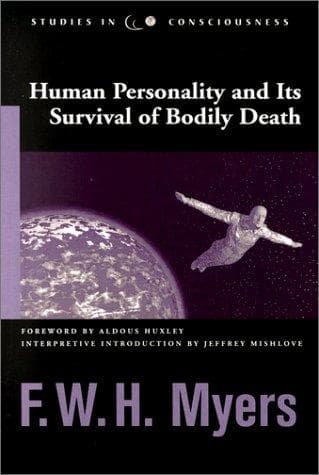
Human Personality and Its Survival of Bodily DeathMyers, F. W. H. (Frederic William Henry)
Religion
Human Personality and Its Survival of Bodily Death
Myers, F. W. H. (Frederic William Henry)
Immortality; Parapsychology; Personality
that occur; and if that percentage is decidedly exceeded, there is
reason to surmise that some other cause than chance--in other
words, some objective origin for the phantasm--is present."
But on the other hand, a phantasm representing a person whose death is
recent is specially likely to arouse interest and, in cases where the
death is previously known to the percipient, his emotional state may be
considered a sufficient cause of the hallucination.
"If, then," Gurney continues, "we are to draw any probable
conclusion as to the objective nature of _post-mortem_ appearances
and communications (or of some of them) from the fact of their
special frequency soon after death, we must confine ourselves to
cases where the fact of death has been unknown to the percipient at
the time of his experience. Now, in these days of letters and
telegrams, people for the most part hear of the deaths of friends
and relatives within a very few days, sometimes within a very few
hours, after the death occurs; so that appearances of the sort
required would, as a rule, have to follow very closely indeed on
the death. Have we evidence of any considerable number of such
cases?
"Readers of _Phantasms of the Living_ will know that we have. In a
number of cases which were treated in that book as examples of
telepathic transference from a dying person, the person was
actually dead at the time that the percipient's experience
occurred; and the inclusion of such cases under the title of
_Phantasms of the Living_ naturally occasioned a certain amount of
adverse criticism. Their inclusion, it will be remembered, required
an assumption which cannot by any means be regarded as certain. We
had to suppose that the telepathic transfer took place just before,
or exactly at, the moment of death; but that the impression
remained latent in the percipient's mind, and only after an
interval emerged into his consciousness, whether as waking vision
or as dream or in some other form. Now, as a provisional
hypothesis, I think that this assumption was justified. For in the
first place, the moment of death is, in time, the central point of
a cluster of abnormal experiences occurring to percipients at a
distance, of which some _precede_, while others follow, the death;
it is natural, therefore, to surmise that the same explanation will
cover the whole group, and that the motive force in each of its
divisions lies in a state of the 'agent' prior to bodily death. In
the second place, some of the facts of experimental
thought-transference countenance the view that 'transferred
impressions' may be latent for a time before the recipient becomes
aware of them; and recent discoveries with respect to the whole
subject of automatism and 'secondary intelligence' make it seem far
Public-domain text, read in full here on John Shaqi.
Reviews
Reviews
No reviews yet
Be the first to share your thoughts on this work.
Elsewhere in the archive
Join the Discussion
Join the discussion
Sign in to leave a comment or review.
Sign InorCreate an account