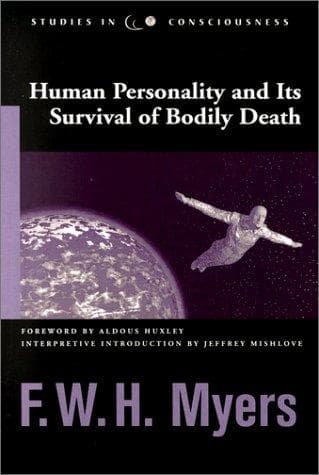
Human Personality and Its Survival of Bodily DeathMyers, F. W. H. (Frederic William Henry)
Religion
Human Personality and Its Survival of Bodily Death
Myers, F. W. H. (Frederic William Henry)
Immortality; Parapsychology; Personality
But I shall begin by referring to a small group of cases,[140] which I
admit to be anomalous and non-evidential--for we cannot prove that they
were more than subjective experiences--yet which certainly should not be
lost, filling as they do, in all their grotesqueness, a niche in our
series otherwise as yet vacant. If man's spirit is separated at death
from his organism, there must needs be cases where that separation,
although apparently, is not really complete. There must be subjective
sensations corresponding to the objective external facts of apparent
death and subsequent resuscitation. Nor need it surprise those who may
have followed my general argument, if those subjective sensations should
prove to be dreamlike and fantastic. Here, as so often in our inquiries,
the very oddity and unexpectedness of the details--the absence of that
solemnity which one would think the dying man's own mind would have
infused into the occasion--may point to the existence of some reality
beneath the grotesque symbolism of the transitional dream.
The transitional dream, I call it, for it seems to me not
improbable--remote though such a view may be from current notions--that
the passage from one state to another may sometimes be accompanied with
some temporary lack of adjustment between experiences taking place in
such different environments--between the systems of symbolism belonging
to the one and to the other state. But the reason why I refer to the
cases in this place is that here we have perhaps our nearest possible
approach to the sensations of the spirit which is endeavouring to
manifest itself;--an inside view of a would-be apparition. The
narratives suggest, moreover, that spirits recently freed from the body
may enjoy a fuller perception of earthly scenes than it is afterwards
possible to retain, and that thus the predominance of apparitions of the
_recently_ dead may be to some extent explained.
We have, indeed, very few cases where actual apparitions give evidence
of any _continuity_ in the knowledge possessed by a spirit of friends on
earth. Such evidence is, naturally enough, more often furnished by
automatic script or utterance. But there is one case (which I give in
Appendix VII. A) where a spirit is recorded as appearing repeatedly--in
guardian-angel fashion--and especially as foreseeing and sympathising
with the survivor's future marriage.
Public-domain text, read in full here on John Shaqi.
Reviews
Reviews
No reviews yet
Be the first to share your thoughts on this work.
Elsewhere in the archive
Join the Discussion
Join the discussion
Sign in to leave a comment or review.
Sign InorCreate an account